As an industrial magnet supplier, I've had the privilege of delving deep into the fascinating world of magnets and their properties. One particular property that often goes unnoticed but plays a crucial role in the performance and durability of industrial magnets is Poisson's ratio. In this blog post, I'll explore the Poisson's ratio properties of industrial magnets, its significance, and how it impacts various types of magnets in our product line.
Understanding Poisson's Ratio
Poisson's ratio is a fundamental concept in the field of materials science and engineering. It describes the relationship between the lateral strain (the change in width or diameter) and the longitudinal strain (the change in length) of a material when subjected to an external force. Mathematically, Poisson's ratio (ν) is defined as the negative ratio of the transverse strain to the axial strain:
[ \nu = -\frac{\varepsilon_{transverse}}{\varepsilon_{axial}} ]
In simpler terms, when a material is stretched or compressed in one direction, it will also deform in the perpendicular directions. Poisson's ratio quantifies this deformation behavior. For example, when you pull a rubber band, it not only gets longer (longitudinal strain) but also becomes thinner (lateral strain). The ratio of the thinning to the lengthening is Poisson's ratio.
Significance of Poisson's Ratio in Industrial Magnets
The Poisson's ratio of an industrial magnet is important for several reasons. Firstly, it affects the mechanical stability of the magnet. When a magnet is subjected to external forces, such as during installation, operation, or handling, the Poisson's ratio determines how the magnet will deform. A magnet with an appropriate Poisson's ratio will be more resistant to cracking, chipping, or other forms of mechanical damage.
Secondly, the Poisson's ratio influences the magnetic performance of the magnet. Changes in the dimensions of a magnet due to deformation can alter its magnetic field distribution and strength. This can have a significant impact on the functionality of the magnet in various applications, such as magnetic separators, motors, generators, and sensors.
Poisson's Ratio Properties of Different Types of Industrial Magnets
Let's take a closer look at the Poisson's ratio properties of some common types of industrial magnets in our product line.
Neodymium Iron Boron (NdFeB) Magnets
Neodymium magnets are known for their exceptional magnetic strength, making them one of the most widely used types of industrial magnets. The Poisson's ratio of NdFeB magnets typically ranges from 0.25 to 0.35. This relatively low Poisson's ratio indicates that NdFeB magnets are less prone to lateral deformation when subjected to axial forces. As a result, they offer good mechanical stability and can withstand high levels of stress without significant damage.
However, it's important to note that the Poisson's ratio of NdFeB magnets can vary depending on factors such as the manufacturing process, composition, and temperature. For example, magnets with a higher percentage of neodymium may have a slightly different Poisson's ratio compared to those with a lower percentage. Additionally, extreme temperatures can also affect the Poisson's ratio, potentially leading to changes in the magnet's mechanical and magnetic properties.
Ferrite Magnets
Ferrite magnets, also known as ceramic magnets, are another popular choice for industrial applications due to their low cost, good corrosion resistance, and moderate magnetic strength. The Poisson's ratio of ferrite magnets is typically in the range of 0.2 to 0.25. This relatively low value indicates that ferrite magnets are less likely to undergo significant lateral deformation when subjected to axial forces.
One of the advantages of ferrite magnets is their high thermal stability. Unlike NdFeB magnets, which can experience a significant reduction in magnetic strength at high temperatures, ferrite magnets maintain their magnetic properties over a wide temperature range. This makes them suitable for applications where the magnet will be exposed to elevated temperatures, such as in automotive engines and industrial furnaces.
Alnico Magnets
Alnico magnets are made from an alloy of aluminum, nickel, and cobalt, and they are known for their high coercivity and excellent temperature stability. The Poisson's ratio of Alnico magnets is typically around 0.3. This value indicates that Alnico magnets are more likely to undergo lateral deformation compared to NdFeB and ferrite magnets.
Despite their relatively high Poisson's ratio, Alnico magnets offer good mechanical strength and can withstand high levels of stress. They are commonly used in applications where high magnetic field strength and temperature stability are required, such as in electric motors, generators, and magnetic sensors.
Impact of Poisson's Ratio on Magnet Design and Application
The Poisson's ratio of an industrial magnet has a significant impact on its design and application. When designing a magnet for a specific application, engineers must consider the expected forces and stresses that the magnet will be subjected to, as well as the desired magnetic performance. By selecting a magnet with an appropriate Poisson's ratio, engineers can ensure that the magnet will maintain its mechanical integrity and magnetic properties over its lifetime.
For example, in applications where the magnet will be subjected to high levels of stress, such as in magnetic separators or lifting magnets, a magnet with a low Poisson's ratio may be preferred. This will help to minimize the risk of mechanical damage and ensure the long-term reliability of the magnet. On the other hand, in applications where the magnet will be exposed to high temperatures, such as in electric motors or generators, a magnet with good thermal stability and a suitable Poisson's ratio may be required.
Our Product Line and Poisson's Ratio
At our company, we offer a wide range of industrial magnets, including Rubber Coated Pot Magnet, Ferrite Pot Magnet, and Shallow Pot Magnet. Each of these magnets has its own unique Poisson's ratio properties, which are carefully considered during the manufacturing process to ensure optimal performance and durability.
Our rubber coated pot magnets are designed to provide a secure and reliable holding force in a variety of applications. The rubber coating not only protects the magnet from damage but also provides a non-slip surface for easy handling. The Poisson's ratio of our rubber coated pot magnets is carefully balanced to ensure that they can withstand the forces and stresses associated with their intended use.
Our ferrite pot magnets are known for their excellent corrosion resistance and moderate magnetic strength. They are commonly used in applications where a low-cost, reliable magnet is required. The Poisson's ratio of our ferrite pot magnets is optimized to provide good mechanical stability and magnetic performance over a wide temperature range.

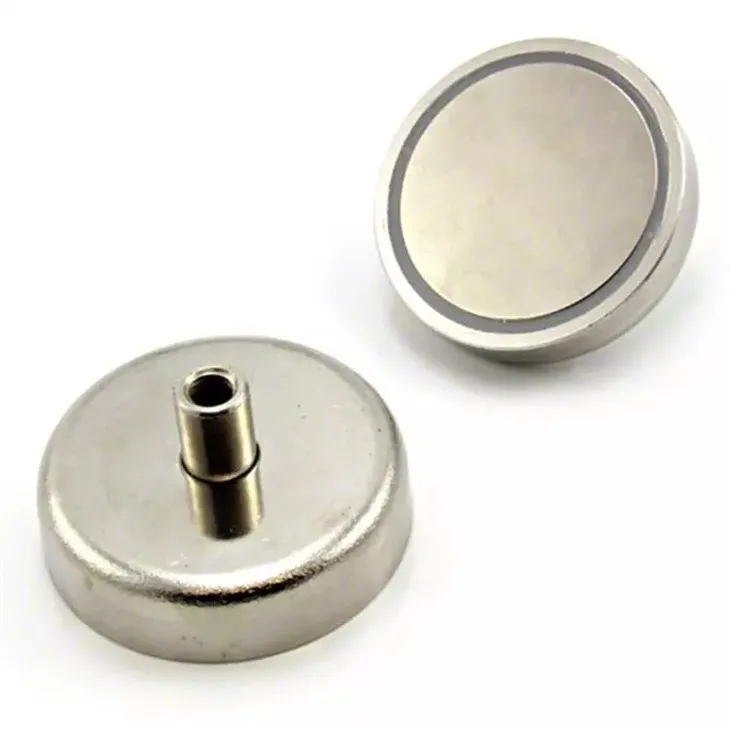
Our shallow pot magnets are designed to provide a high magnetic field strength in a compact package. They are ideal for applications where space is limited, such as in electronic devices and small machinery. The Poisson's ratio of our shallow pot magnets is carefully selected to ensure that they can maintain their magnetic properties under the expected operating conditions.
Conclusion
In conclusion, the Poisson's ratio is an important property of industrial magnets that affects their mechanical stability and magnetic performance. By understanding the Poisson's ratio properties of different types of magnets, engineers can select the most suitable magnet for their specific application. At our company, we are committed to providing high-quality industrial magnets that are designed and manufactured to meet the highest standards of performance and reliability.
If you are interested in learning more about our industrial magnets or have any questions about Poisson's ratio or other magnet properties, please don't hesitate to contact us. We would be happy to discuss your requirements and help you find the right magnet for your application.
References
- Callister, W. D., & Rethwisch, D. G. (2010). Materials Science and Engineering: An Introduction. Wiley.
- Chapman, J. D. (1986). Principles of Electromagnetic Devices. Wiley.
- O'Hanlon, J. F. (1991). A User's Guide to Vacuum Technology. Wiley.