


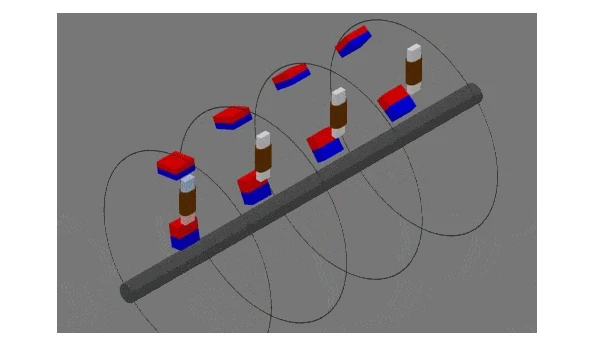
When a magnet is subjected to violent shock and heat, its magnetism weakens. The work done by the magnetic field is always accompanied by a reduction in other energies, such as mechanical energy. The static magnetic field only acts as a medium and does not provide energy. A magnet does not rely on its own magnetism to do work. The first thing we need to make clear is that this is a magnetic field and not an electromagnetic field, let alone an electric field. Magnetic or magnetic force is itself a special "force".
The magnetic essence of a magnet is the viewer inside the magnet, so what is the essence? Is a strong basic strong magnetic force, is a subatomic spin at the speed of light caused by the negative pressure difference between the north and South Pole excited vacuum field gravity. Whatever the force is, it's a superposition of strong magnetic forces, whose poles are aligned. As long as the small magnetic field inside the magnet doesn't somehow get confused with the direction of the pole, the magnet doesn't lose its magnetism. That's the nature of magnetism.
Permanent magnet! Such as NdFeb alloy, magnetite, motor rotor, speaker magnet and so on. , are the relatively ordered magnetic domains of atomic or molecular crystals, resulting in the weakening of the repulsion and attraction of the intrinsic magnetism obviously. A magnet is called a permanent magnet because of its permanent magnetism.
Magnetic field Magnetism is the best reflection of the superposition of the homogenous strong repulsive and gravitational effects, especially the ordered arrangement of the cellular magnetic domains of atomic units. Magnetic energy or magnetic field energy, although the kinetic energy of electrons for energy conversion can be calculated as a substitute parameter, is still an intrinsic potential energy. So a magnet doesn't lose its magnetism by working or not working.


