


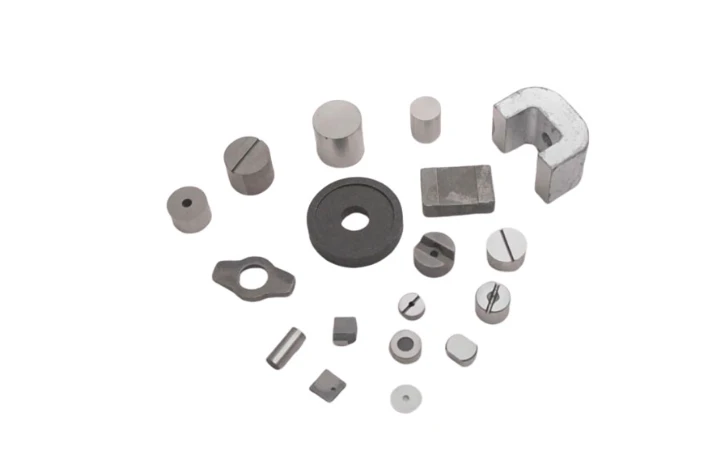
Neodymium magnets There are two types of magnets: sintered ndFeb and bonded NdFeb. So how do you distinguish between sintered magnets and bonded magnets? The difference between sintering and bonding is the process, as well as the properties and price. In fact, for a magnet manufacturer, customer demand is the key to determining sintering and bonding. But this article is still talking about sintering and bonding ndfeb which performance is better.
Ndfeb is a man-made permanent magnet with the strongest magnetic force at present. So how do you distinguish between sintering and bonding? In fact, sintering and bonding are NdFeb. The difference between sintering and bonding is based on their production techniques. Sintering is through the NdFeb magnet to draw out part of the space, and then high temperature heating formed. But sintered Ndfeb corrosion resistance is poor, the surface is easy to oxidation, the need for electroplating. Generally used galvanized, nickel plating, gold plating; And the price is higher. Sintered NdFeb magnetization mode has axial and radial magnetization, can be customized according to customer needs.
Bonded Ndfeb is injection molded, so it contains a binder. Its magnetic between sintered NdFeb and ferrite magnets, high dimensional accuracy, shape freedom. The shape and size of the product are determined by the mold. Can be made into ring, tile, square and other shapes, without sintering and post-processing. Good corrosion resistance; After electrophoretic coating or some treatment, it can be used in the everyday environment. Diversification of magnetization modes; The magnetic pole can be recharged into a multipole or skew pole, and the waveform can be a square wave, sine wave, etc. Suitable for mass production, high production efficiency. Compared with sintering, the magnetic properties are weaker and the price is lower.
Bonded ndFeb magnetic only sintered NdFeb about 5%. At present sintered NdFeb magnetic energy product up to 50m above, high temperature resistance effect is good. And the high temperature resistance effect of bonded ndFeb is generally about 12m, so the application range of sintered NdFeb is wider than that of bonded NdFeb.


