


(1) Introduction to the performance of magnets
Strong magnetism refers to strong magnets, professional name: rare earth strong magnetism, NdFeB, this kind of magnet generally has relatively high performance, commonly used in toys, packaging boxes, lamps, handicrafts, speakers, medical machinery, health care products, electronic products, hardware tools and other products, generally N33, N35, N38 is appropriate, these three are NdFeB strong magnetic ordinary performance, a normal case, if the requirements are not very high, these three performance magnets are similar.
N40 or above high performance: This performance is generally used in mobile phones, precision instruments, aerospace, cutting-edge scientific research, can be divided into: N40, N42, N45, N48, N50, N52 nine kinds. The above nine properties are temperature resistant at ≤80 °C, and once this temperature is exceeded, it will be demagnetized.
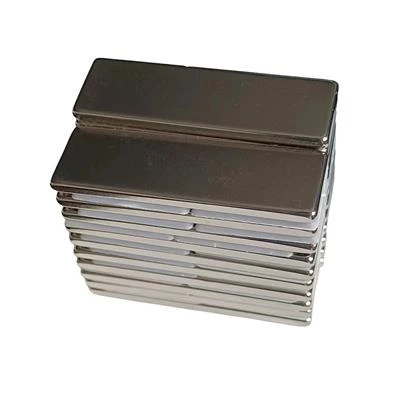
(2) Magnet material grade
1. Magnet material grade
In order to facilitate the distinction of permanent magnets of different materials and facilitate people's recognition, most factories use fixed letters to represent different magnets, such as the common N35 magnet, N means that the magnet is NdFeB, Y represents permanent magnet ferrite, if it is PCx, such as PC40, it is a soft magnetic ferrite with high permeability.
2. Sintered NdFeB grade
The grade of sintered NdFeB permanent magnet material consists of three parts: the main name and two magnetic properties, part of which is the main name, which is simplified to N by the chemical symbol ND of neodymium, the number of the second part is the nominal value of the large magnetic energy product (BH) max of the material (in units KA/m3), and the letter of the third part indicates the operating temperature of the magnet. Grade example: N35H indicates (BH) max of about 35MGOe (280 KA/m3) and an operating temperature of 120 °C sintered NdFeB permanent magnet material.
NdFeB magnetic material grades: N30~N52; 30H~50H; 30SH~50SH; 28UH~40UH; 30EH~35EH, etc.
3. Working temperature corresponding to different grades
The large operating temperature corresponding to different brands is basically the same among manufacturers:
1) There is no letter after the data, for example: N35 temperature resistance is generally ≤80 °C
2) The data ends with M after it, for example: N50M temperature resistance is generally ≤ 100 °C
3) The data ends with H, for example: N48M temperature resistance is generally ≤120°C
4) The data ends with SH, for example: N45SH The temperature resistance is generally ≤ 150°C
5) The data ends with UH, for example: N35UH temperature resistance is generally ≤ 180°C
6) The data ends with EH, for example: N50M temperature resistance is generally ≤ 200 °C
7) The data ends with EH, for example: N50M temperature resistance is generally ≤220°C
The latter five properties are all high-temperature resistant types, and if the established temperature exceeds the latter, the magnet will demagnetize.
High-temperature magnets, such as 38SH, are temperature-resistant 150-degree magnets, and the magnetic force is equivalent to N38 at room temperature. Here it should be mentioned that at the same 70 degrees temperature, 38SH working performance is much better than N38, of course, needless to say 90 degrees 100 degrees, NdFeB magnets avoid high temperature, N brand magnets are 80 degrees high temperature.
(3) Residual magnetism
Short for residual magnetization (remanence), symbol Br. Remanence Br: After the permanent magnet is magnetized to technical saturation and the external magnetic field is removed, the retained Br is called the residual magnetic induction intensity.
(4) Introduction to coercivity
The coercive force unit is Oster (Oe) or Ampere per meter (A/m), 1 A/m = 79.6 Oe. Coercivity is divided into magnetic induction coercivity (Hcb) and intrinsic coercivity (Hcj).
1. Magnetic induction coercivity
When the magnet is reverse-magnetized, the value of the required reverse magnetic field strength to reduce the magnetic induction intensity to zero is called the magnetic induction coercive force. However, at this time, the magnetization strength of the magnet is not zero, but the applied reverse magnetic field cancels out the magnetization strength of the magnet. The external magnetic induction intensity is zero, and if the external magnetic field is withdrawn, the magnet still has certain magnetic properties.
2. Internal coercivity
The reverse magnetic field strength required to reduce the magnetization of the magnet to zero is called internal coercivity. Intrinsic coercivity is a physical quantity that measures the anti-demagnetization ability of a magnet, and is a coercive force that indicates that the magnetization strength M in the material regresses to zero. In the use of magnets, the higher the coercivity of the magnet, the better the temperature stability.
(5) Large magnetic energy product
The large magnetic energy product represents the magnetic energy density established by the magnet in the air gap space (magnet two-pole space), that is, the static magnetic energy per unit volume of the air gap. Since this energy is equal to the product of the magnet's Bm and Hm, it is called the magnetic energy product.
(6) Working temperature
Magnet grades vary from N35 to currently N52 according to magnet magnetic properties. Some manufacturers have N44 grades, some direct N45 grades, and other grades are basically the same. N series 80 degrees larger; M series 100 degrees larger; H large 120 degrees; SH 150 degrees larger; UH 180 degrees larger; EH 200 degrees larger; AH 220 degrees bigger.
(7) Surface treatment (coating)
NdFeB magnet coating: nickel, copper, chromium, gold, black zinc, epoxy resin. Its surface plating is not the same, the color and storage time are different, each has its own advantages, but also disadvantages.
1. Galvanized
The surface looks silvery-white, can do 12-48 hours salt spray, can be used in some glue bonding (such as AB glue), such as electroplating can be stored for two to five years, its advantage is relatively low price.
2. Nickel plating
It seems to be stainless steel color, the surface left in the air is difficult to be oxidized, and the appearance is good, the gloss is good, and the electroplating can pass the salt spray test for 12-72 hours. The disadvantage is that it cannot be bonded with some glue, which will cause the plating to fall off. Accelerate oxidation, now the market mostly uses nickel-copper-nickel plating to do 120-200 hours, but its electroplating cost is relatively high.
3. Black zinc plating
According to customer requirements, the surface of its products is treated into black, in the electroplating process, mainly on the basis of galvanizing through chemical treatment plus a layer of black protective film, this film can also play a role in protecting the product, increase salt spray time, prolong the oxidation time. However, its surface is easily scratched and loses its protective effect. Now there are very few people who use it, and most of them are replaced by resin.
4. Gold plating
The industry is hot right now, and some of the stalls we saw on the street had yellow gold jewelry mostly gilded or copper. Gold plating makes the appearance of the product look like gold, very beautiful, generally used in the jewelry industry, magnet products can also be gold plated, used in magnetic jewelry.
5. Epoxy plating
After the product is nickel-plated and then coated with a layer of resin paint outside, this industry has a market for nearly two years, its development speed is very fast, now a variety of electroplating products on the use of many people, its big advantage is that you can do the color you want.


