


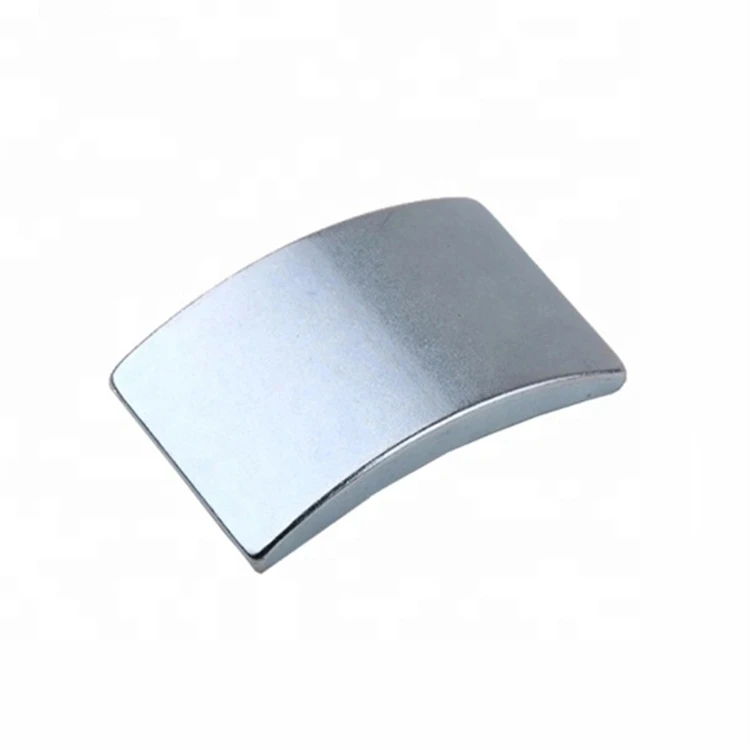
Crane motor magnet
An electromagnet used to lift or unload ferromagnetism. Industry is generally lifting or loading and unloading iron ore, iron ore, scrap steel, steel ingot, rail and a variety of steel and steel workpiece. Crane electromagnets are usually formed as discs or rectangles with inner and outer magnetic poles. After the excitation coil is energized, the inner and outer magnetic poles are magnetized, attracting steel material or workpiece (equivalent to the armature of general electromagnet), forming a closed magnetic circuit. In order to protect the field winding from mechanical impact between the pole and the object being attracted, lifting electromagnets are usually of carapace construction with DC excitation.
Traction motor magnet
An electromagnet used to draw and repel mechanical devices. It is mainly used for various automatic equipment to realize remote control. In order to obtain a large electromagnetic attraction on a long stroke, traction electromagnet generally uses a relatively flat attraction characteristics of the shell structure. Its internal built-in iron core, armature, excitation coil. In use, the iron core is fixed to the stationary part of the mechanism and the armature is connected to the tie rod. When the excitation coil is energized, the iron core is magnetized, creating an electromagnetic attraction to attract the armature, which operates the mechanism of the mechanism controlled by the tie rod. In order to meet the needs of different control objects, traction electromagnet has two kinds of traction and propulsion, but they do not have a reset device. The main technical indexes of traction electromagnet are electromagnetic suction force, operating frequency and life under certain stroke.
Brake motor magnet
An electromagnet for mechanical braking. Mainly used for electric driving devices and hoisting equipment, combined with the brake to prevent the motor from correctly stopping, suspended heavy objects falling. The brake electromagnet can be divided into long stroke and short stroke according to the stroke of the armature. According to the different excitation mode, there are DC and AC, parallel excitation and series excitation, single phase and three equal types. The principle of the brake electromagnet is that after the coil of the electromagnet is energized, the armature is attracted to the iron core and presses the brake rod to move it in the brake stop section, thus releasing the brake. After cutting the power supply to the coil, the brake lever, under the action of the spring, disengages the armature from the yoke, and the brake stops the mechanism temporarily. The main technical parameters of the braking electromagnet are stroke, electromagnetic suction force under a certain stroke, operating frequency, power-on duration. Operation frequency refers to the number of operations per hour. Power-on duration is the percentage of the sum of power-on time, power-on time, and non-power-on time. In use, brake electromagnet and tile brake combination use short stroke class; When combined with belt brake, use long travel class. Brake electromagnet is called hydraulic control electromagnet, through the hydraulic transfer of electromagnetic force to the brake mechanism. Valve electromagnet
Electromagnet for remote operation of valves of various hydraulic and pneumatic systems. It is often used in various metal cutting machine tools. Valve does not use electromagnet to set the reset device, with the valve body in the spring reset. When the current flows through the electromagnet exciting coil, electromagnetic attraction resistance spring resistance, so that the valve body push rod move, open the valve, the power supply of the excitation coil is cut off, under the action of the reset spring, the valve body push rod push armature, move to the rated stroke position, the valve is closed. Valve electromagnet is divided into wet type and dry type. The armature of the wet valve electromagnet works in the hydraulic oil, through the cooling action of the oil, and the size is smaller than the electromagnet with the same attraction.
Applications of motor magnets
Threshold: Why does the threshold "hold" the door firmly when not using the card? The original unit door is made of steel. Its metal body, when energized, generates a strong magnetic field, which can be firmly attached to the door. The moment the card is applied, the current is cut off, the metal loses its magnetism, and we can open the door. That metal body is actually an electromagnet.
Motor magnet crane: One of the most direct applications is the electromagnetic crane. The electromagnet is mounted on the crane, and the electricity pulls up a large amount of steel. When it moves to another location, the current is cut off, and the steel is lowered, saving the trouble of strapping. Large electromagnetic cranes can lift several tons of steel at a time.
Electromagnets are also used in motors, generators, bells, and electromagnetic relays. Automatic washing machine water supply, drainage valve, toilet induction flush valve is also controlled by electromagnet.
Another application of motor magnets is the generation of strong magnetic fields. In modern technology, large motor, generator, magnetic therapy equipment and many other places required by the strong magnetic field is provided by the electromagnet.


