


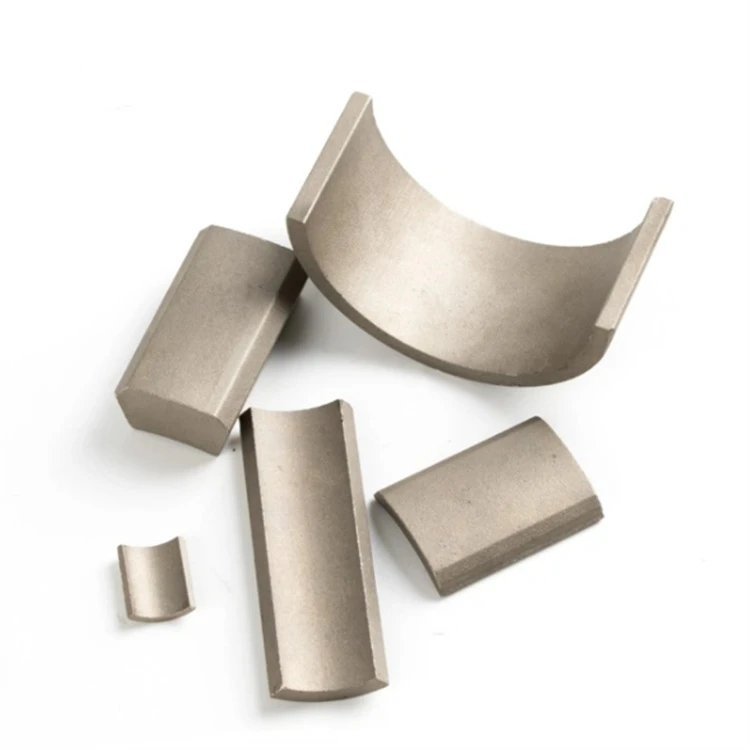
The technical problem to be solved by the invention is to overcome the deficiency of the prior art and provide a high coercivity samarium cobalt permanent magnet material. The technical scheme adopted by the invention is to provide a samarium cobalt magnet permanent magnet material composed of samarium, cobalt, iron, copper, zirconium and heavy rare earth elements, and the mass percentage of samarium is 23-25. 5%, Cobalt 44 50%, iron 14 20% and copper. Preferably, one of the heavy rare earth elements is erbium. Another technical problem to be solved by the invention is to provide a manufacturing method of the samarium cobalt permanent magnet material of the invention, by which the samarium cobalt permanent magnet material manufactured has high coercivity. Manufacturing method of samarium cobalt permanent magnet materials, including the following steps:
1) Raw materials samarium, cobalt, iron, copper, zirconium and a heavy rare earth element are mixed by mass percentage. Samarium 23 25. 5%, Cobalt 44 50%, iron 14 20%, copper 3 8%, zirconium 2 4%, heavy rare earth 0 5%.
2) The raw material obtained by dissolving the alloy is dissolved in a vacuum medium frequency induction furnace, after which the samarium cobalt alloy is injected into the mold after being refined at 1430 ℃(1450 ℃) for 5 minutes. Generally, water-cooled copper molds are preferred.
3) Manufacturing of magnetic powder Sm-Co alloy is crushed and ball milled with hydrogen to obtain magnetic powder with a particle size of 3.05.0m. Hydrogen crushing means that hydrogen passes through a reaction vessel equipped with samarium cobalt alloy, the pressure of hydrogen reaches IMPa, the temperature rises to 150℃, and the temperature is held for 20h, so that samarium cobalt alloy and hydrogen undergo hydrogen-storage reaction and become saturated. After the reaction, the temperature was raised to 300~400℃. Keep the pool warm and fully dehydrogenate the reaction products. In this process, the samarium cobalt alloy breaks along the grain boundary, and the magnet is pulverized while maintaining the integrity of the crystal.
4) The orientated magnetic powder was oriented in a magnetic field of 1.8±2.0t, pressed into shape, and cold isostatic pressure at 200(300 ml) pressure to obtain the first samarium cobalt blank.
5) Solid solution sintering is carried out in the sintering furnace. The first samarium cobalt temporarily sintered body is unbalanced under the protection of inert gas argon, and the whole sintered body is temporarily sintered for 20 ~ 30 minutes at 1050 ~ 1180 and 90 minutes at 1200 ~ 1210 for the second sintering. The third solution was sintered at 1168 ~ 1190 for 90 minutes. This non-equilibrium sintering method refers to real-time monitoring of the heating pairs of multiple blocks in the sintering furnace, as well as
6) Aging treatment is to keep the second samarium cobalt blank at 835 ℃(7845 ℃) for h, cool it at 0.5 (0.6/min) to 400 ℃, maintain this temperature 3 plutonium, and then air cooling to room temperature to obtain samarium cobalt magnets. Compared with the previous formulation, the invention is a formulation containing the element erbium, and the samarium cobalt alloy has a cellular structure. Grain boundary precipitates also nail the domain walls, and the increase of Er leads to the increase of grain boundary precipitates. It is known that the content of zirconium in the invention is 2.4%, which is 1.3% higher than that in the usual formula. The content of zirconium can improve the resistance to external reverse magnetic field and other demagnetization effects. Zirconium promotes the formation of sheet 2:17 phase, and the increase of sheet phase is conducive to the improvement of coercivity.
Through the addition of erbium and reasonable formula ratio, the intrinsic coercivity Hcj of the prepared samarium cobalt magnet material reaches 27% koe, much higher than the existing formula of about 20K0e, which effectively meets the high coercivity requirements of samarium cobalt magnet materials in the high-tech field. In the manufacturing method of samarium cobalt permanent magnet material, samarium cobalt alloy ingot is crushed by hydrogen crushing process, sintering temperature of each temperature zone in sintering furnace is the same, non-equilibrium sintering method forms more uniform microstructure, which also improves coercivity to a certain extent. The invention ages samarium cobalt billet with a cooling rate lower than that of the prior art. By slowing down the cooling rate, the samarium cobalt alloy is fully miscible, the microstructure is more uniform, the size is reduced, the coercivity is improved, and the demagnetization such as external reverse magnetic field is prevented.


