


Magnetic hooks are ubiquitously employed for creating temporary mounting solutions in both industrial and domestic settings. However, their efficacy on non-ferromagnetic materials such as aluminum remains a subject of technical scrutiny. This article explores the fundamental principles governing magnetic adhesion, the intrinsic properties of aluminum, and pragmatic considerations for evaluating magnetic hook compatibility.
1. The Physics of Magnetic Adhesion
Magnetic hooks rely on ferromagnetism, a phenomenon where certain materials (e.g., iron, nickel, cobalt) exhibit strong, spontaneous magnetization in the presence of an external magnetic field. Permanent magnets generate a static magnetic field that induces alignment of domains within ferromagnetic substrates, enabling strong adhesion forces. The adhesive force is directly proportional to the permeability and thickness of the target material, as described by the Maxwell stress tensor.
Aluminum, however, belongs to the paramagnetic category of materials. While paramagnetic substances exhibit weak attraction to magnetic fields, they lack the domain structure necessary for sustained magnetization. Consequently, classical permanent magnets cannot establish a stable magnetic circuit with aluminum, rendering conventional magnetic hooks ineffective.
2. Aluminum's Magnetic Properties
Aluminum possesses weak paramagnetism due to its electronic configuration. Its magnetic susceptibility (χ) is approximately +2.2 × 10⁻⁵, orders of magnitude lower than ferromagnetic materials (χ ~ 10³⁴). This paramagnetism arises from unpaired electrons in its conduction band, which align slightly with applied magnetic fields-a transient effect incapable of sustaining practical adhesion forces.
Additionally, aluminum's high electrical conductivity introduces eddy current effects when exposed to dynamic magnetic fields. These currents generate opposing magnetic fields (Lenz's Law), further diminishing net attraction during relative motion between the magnet and aluminum surface. In static scenarios, eddy currents are negligible, leaving only weak paramagnetic interactions.
3. Practical Limitations and Alternatives
For robust adhesion, the magnetic flux density (B) must penetrate the target material to form a closed circuit. Aluminum's low permeability (μₐᵢ ≈ 1.000022) impedes flux concentration, resulting in minimal pull force. Even high-strength neodymium magnets (e.g., N52 grade) exhibit <5% of their nominal holding capacity on aluminum substrates.
Applications requiring non-permanent attachment to aluminum should consider alternative solutions:
Mechanical fasteners: Screws, clamps, or suction cups.
Adhesive-based systems: Pressure-sensitive tapes or epoxy.
Modified magnetic approaches: Indirect mounting via ferromagnetic backplates or multi-layer hybrids (combining aluminum with steel interfaces).
Use the principle of mutual attraction of magnets: for example, place a magnet inside the aluminum gutter and another magnetic hook on the outside to hold it.
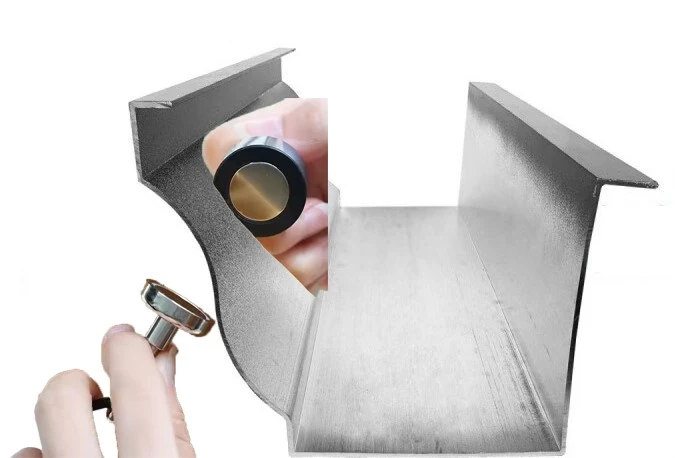
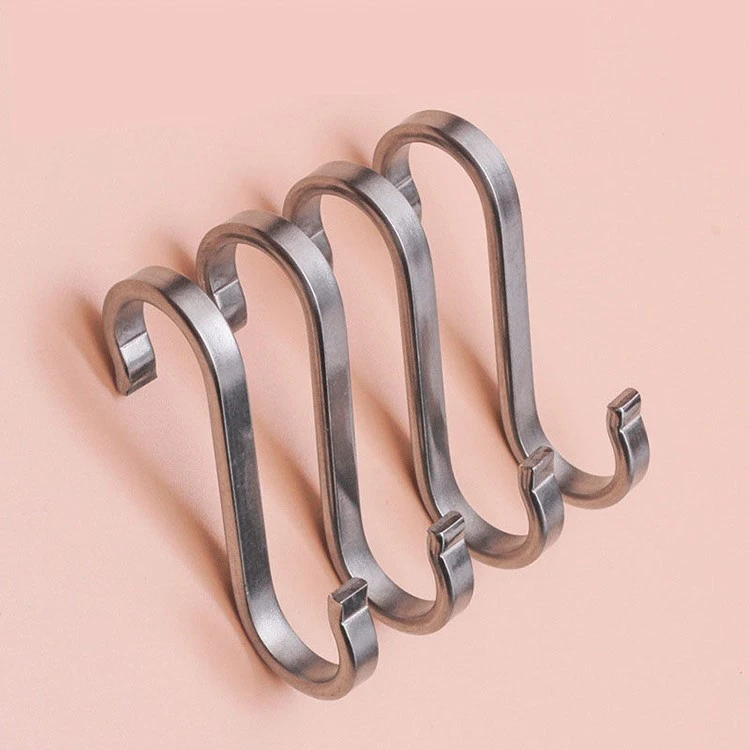
Some aluminum products have edges that are convenient for hanging with hooks, so you can use simple hooks instead.
4. Key Considerations for Engineers
When designing for aluminum surfaces:
Distinguish static vs. dynamic systems: Time-varying magnetic fields (e.g., electromagnets) interact differently due to eddy currents.
Surface finish and geometry: Irregularities amplify air gaps in the magnetic circuit, exponentially reducing adhesion.
Temperature sensitivity: Aluminum's conductivity increases at lower temperatures, enhancing eddy current losses.
Conclusion
Magnetic hooks are fundamentally incompatible with aluminum in traditional configurations due to its paramagnetic nature and poor permeability. Phantom claims of "aluminum-compatible" magnetic hooks often misrepresent transient forces or require engineered composite substrates. For reliable performance, adheren must align with the electromagnetic realities of the target material-underscoring the importance of material science in magnetic system design.


