


The method of lifting the precast concrete slab is as follows:
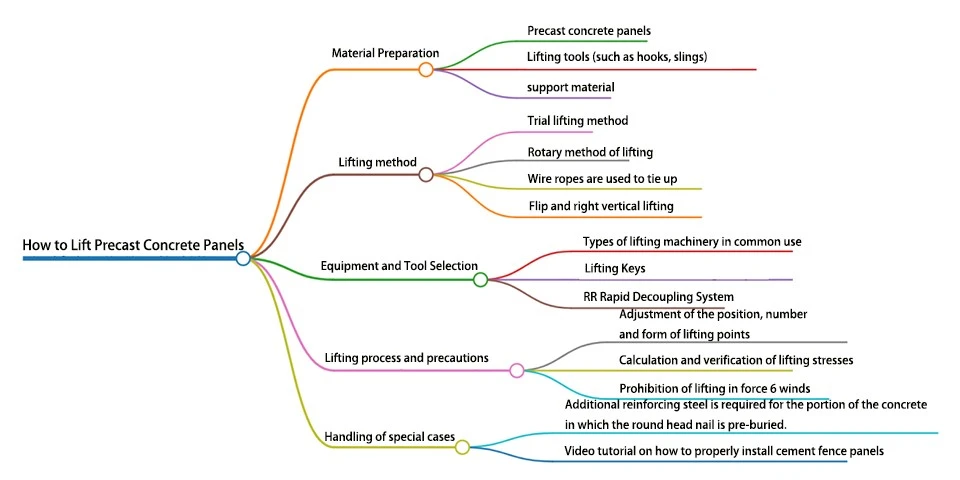
Mind map about How to lift precast concrete panels
1. Preparation: Before installing the precast concrete slab, the following materials need to be prepared:
1.1. Precast concrete slab: Select the precast concrete slab of appropriate specifications according to the requirements of the construction drawings.
1.2. Lifting tools: Select the appropriate lifting tools, such as hooks, slings, etc., according to the size and weight of the precast concrete slab.
1.3. Support materials: Support materials are required during installation.
2. Trial lifting: Before formal lifting, a trial lifting should be carried out to ensure the safety and reliability of the lifting process.
3. Lifting method:
3.1. Rotation method lifting: The method of gradually lifting the precast slab by rotating the crane while lifting the hook is called the rotation method.
3.2. Wire rope binding: If the surface of the precast slab is flat and there is no place to hook it, you can use a wire rope to tie the slab around the waist, and use two hooks to hook the midpoint of the long side of the rope loop to lift it.
3.3. Pre-embedded metal nails: Pre-embedded precast concrete lifting anchors are pre-embedded in prefabricated components before pouring, and the lifting operation is completed by special hook lifting equipment. The matching lifting equipment (Lifting keys) must be used during lifting to prevent safety accidents.
4. Selection of lifting equipment: Determine the flip lifting method according to the size, shape and capacity of the prefabricated concrete slab. Commonly used lifting machinery includes crawler cranes and truck cranes.
5. Safety measures:
5.1. Lifting point design: The lifting point should be determined according to its size, weight and rigidity. Horizontal steel mesh with a width greater than 1m should be lifted by four points, and steel skeleton with a span less than 6m should be lifted by two points.
5.2. Lifting stress verification: By verifying the lifting stress of the prefabricated composite KT slab, ensure that the concrete is always in the elastic stage during the lifting process to avoid tensile cracks.
6. Lifting process:
6.1. Measurement and layout: Determine the position and direction of the component to ensure installation accuracy.
6.2. Installation of hoisting steel beams: Install the hoisting steel beams and connect them with the embedded lifting rings.
6.3. Lifting and leveling: Use a crane to lift the precast panels from the carriage or the ground and perform leveling.
6.4. Positioning and fine-tuning: Place the precast panels in the predetermined position and make fine adjustments to ensure that they are vertical and horizontal.
Through the above steps, the hoisting of concrete precast panels can be completed safely and effectively.
How to choose the right hoisting tools according to different types of concrete precast panels?
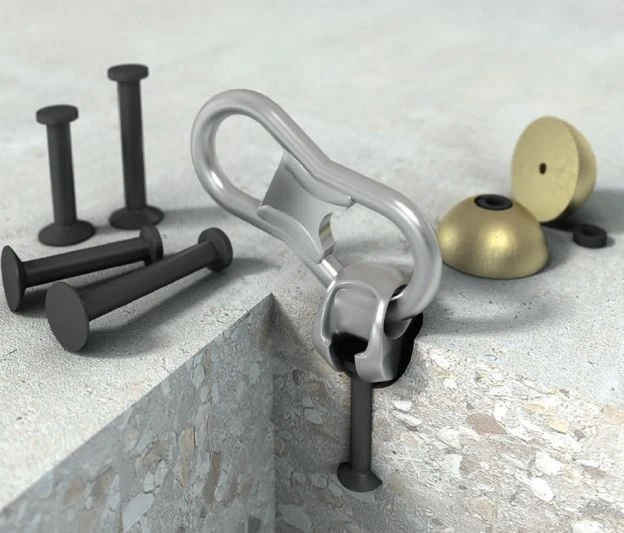
lifting clutch for precast concrete
Choosing the right hoisting tools according to different types of concrete precast panels requires considering multiple factors, including the shape, size, weight of the components, and safety requirements during the hoisting process. The following are detailed steps and suggestions:
1. Determine the shape and size of the components:
1.1. Precast wall panels: Hooks and clamps are usually required to fix the components and ensure the horizontal and vertical position of the components during the hoisting process.
1.2. Floor slabs: The hoisting of floor slabs requires special attention to their flatness and symmetry to avoid displacement or damage during the hoisting process.
2. Choose the right hoist:
2.1. For different types of wall panels, different types of hoists can be selected. For example, when the angle between the wall panel and the wire rope is less than 45 degrees, or when there are four (generally an even number) or more than four lifting points on the wall panel, the corresponding hoist should be selected.
2.2. For specific types of hoists, please refer to the QianCi Magnet QCM model concrete hoist products, which are suitable for various types of prefabricated concrete components.
3. Consider the selection of lifting equipment:
3.1. According to the weight and size of the prefabricated components, choose the appropriate lifting equipment. For example, for heavier prefabricated staircase steps, a flat-top tower crane can be used for lifting.
3.2. The hoisting plan should clearly specify the hoisting equipment and lifting equipment used, and design and calculation should be carried out in accordance with the current relevant national standards.
4. Safety measures:
4.1. During the hoisting process, the safety and reliability of the hoisting equipment and lifting equipment must be ensured to avoid damage to the components due to unbalanced force.
4.2. The use of special lifting systems and accessories, such as the accessories for installing anchors and safety pins provided by the KK lifting system, can improve the safety of the lifting process.
5. Operation process:
5.1. Before lifting, a detailed process planning should be carried out, including hooking, checking the level of components, lifting, installation, positioning, adjustment and fixing.
5.2. During the lifting process, attention should be paid to controlling the lifting speed and angle to avoid unnecessary impact and damage to the components.
During the lifting process of concrete precast panels, how to conduct effective trial lifting to ensure safety and reliability?
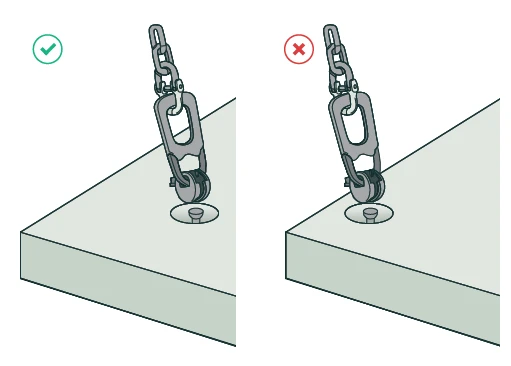
Safe work with precast concrete
During the lifting process of concrete precast panels, it is very important to conduct effective trial lifting to ensure safety and reliability. The following are detailed steps and precautions:
1. Prepare a special construction plan: Before the lifting construction, a special construction plan should be prepared, and the construction personnel should be briefed on quality and safety technology.
2. Set the lifting point: According to the precast panel lifting plan, set the lifting point on the precast panel.
3. Install the lifting device: Install the lifting device on the crane or tower crane, and adjust and check it.
4. Trial lifting inspection:
4.1. Before erecting the beam, a trial lifting inspection should be carried out, and the hook or tie should be placed at the specified lifting point position during the implementation.
4.2. When the prefabricated beam is lifted 20 to 30 cm from the ground, check whether the lifting point is firm, whether the fuselage is stable, and whether the lifting rope is straight and neatly arranged.
4.3. The distance between the hook and the limit device should not be less than 1 meter.
5. Special person to direct the operation: During the lifting process, a special person should be in charge of the operation to ensure construction safety.
6. Quality acceptance: Relevant quality acceptance should be completed before the prefabricated components are lifted. The concrete must reach 22.5Mpa or above before it can be lifted and moved. If there is no clear design, the strength of beams and slabs must not be less than 75% of the design strength before lifting.
7. Operating procedures: Operators must strictly follow the lifting plan and operating procedures, and must not arbitrarily change the lifting method and sequence.
What are the specific safety measures and stress verification methods in the lifting of concrete prefabricated panels?
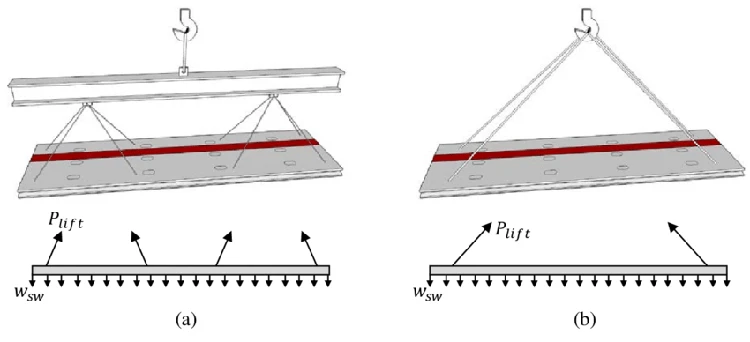
Precast panel lifting points a with lifting beam, b without lifting beam
In the hoisting of concrete precast panels, a series of specific safety measures and stress verification methods need to be taken to ensure the safety of the construction process and the integrity of the components. The following is a detailed description:
Safety measures
1. Command signal: The commander should use color flags, gestures, whistles, etc. to command, and ensure that all personnel are familiar with the command signal.
2. Personal protective equipment: Operators need to wear appropriate personal protective equipment, such as safety helmets, safety shoes and safety ropes.
3. Restrict the entry of non-related personnel: Strictly restrict the entry of non-related personnel in the hoisting area, and set up obvious warning signs to prevent them from contacting the area where the hoisting operation is being carried out.
4. Lifting point position: The lifting point position generally does not coincide with the actual working support point position of the component. Usually, the lifting point is closer to the mid-span than the support point. If the lifting point coincides with the support point, the mid-span bending moment during hoisting will be 20% greater than the mid-span bending moment of the support point under working conditions, which may cause danger.
5. Inspection before lifting: The precast floor slab must be re-checked for external dimensions and weight before lifting, and the axis and horizontal line must be marked on the ring beam and its connection parts for correction.
Stress verification method
1. Stress calculation: During the transportation and lifting stage, the positive stress of the concrete section needs to be calculated. The stress calculation method at this stage is different from that at the prestressing stage. It is necessary to consider factors such as the angle between the tangent of the steel bar and the longitudinal axis of the member and the width of the member web.
2. Standard load combination: Most current specifications require the concrete stress to be verified under the standard load combination. The stress verification method can not only control cracks but also ensure safety.
What special lifting equipment and technology are recommended for large or heavy concrete precast panels?
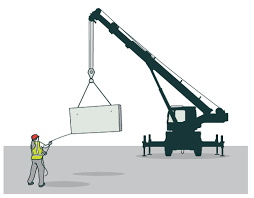
Lifting large or heavy concrete precast panels requires special equipment
For the lifting of large or heavy concrete precast panels, the following special equipment and technology are recommended:
1. Vacuum adsorption crane: This equipment uses a strong suction force through a vacuum pad to lift heavy products with relatively flat surfaces, such as large concrete panels. Suitable for products weighing less than 500 kg.
2. Special hoist: For precast components of specific shapes, such as T-shaped precast concrete stands, specially designed hoists can be used. These hoists are easy and fast to operate, and are easy and safe to unhook.
3. Multi-point lifting technology: The use of embedded anchor bolts, mobile lifting ears and multi-point lifting technology can effectively solve the technical problems of overall prefabrication and lifting of prefabricated components.
4. Plate-type lifting ear structure: This structure is used to suspend concrete components, which can overcome the shortcomings of existing technologies and provide a more stable and safe lifting method.
5. Improved lifting equipment: For example, by improving the lifting equipment, the D-type plate is lifted to the bottom of the beam, and the screw is fixed after adjusting the position, thereby reducing the difficulty of installation and speeding up the construction progress.
What are the leveling steps after the concrete prefabricated plate is hoisted, and how to ensure its verticality and horizontality?
The leveling steps after the concrete prefabricated plate is hoisted are as follows:
1. Fine-tune the hanging plate: First, fine-tune the hanging plate, and use the adjusting screw for coordination control to ensure the horizontality and elevation of the hanging plate are accurate.
2. Adjust the flatness and verticality: Then use the top screw to adjust the flatness and verticality of the hanging plate so that the hanging plate meets the design requirements.
3. Use a level and a ruler: Finally, adjust the hanging board according to the level and the ruler to ensure that the joint width, horizontality and verticality meet the design requirements.
In addition, the methods to ensure the verticality and horizontality of the prefabricated panels include:
Lifting-positioning-preliminary correction: After the prefabricated components are hoisted, the horizontality, in and out, verticality, etc. of the prefabricated components must be adjusted to ensure the accuracy of the components after assembly.
Use wedge blocks or leveling steel plates: Set concrete wedge blocks or leveling steel plates at the bottom of the prefabricated panels to keep the prefabricated panels horizontal and vertical through these devices.


