


Precast concrete square piles assume the key role of foundation bearing in buildings. As the foundation part of the building, the precast concrete square pile carries the load from the superstructure and transfers it to the foundation soil, providing the necessary support to ensure the building's stability and safety.
Precast concrete square piles are of great significance in the construction industry, mainly in the following aspects:
1. Strong bearing capacity: Based on its structural characteristics, concrete square pile has high bearing capacity and is able to withstand large loads, which is suitable for the foundation construction of all kinds of building projects.
2 . High construction efficiency: precast concrete square piles can be prefabricated in the factory and then transported to the construction site for installation, which can greatly shorten the construction period and improve construction efficiency.
3 . Strong adaptability: Concrete piles can be adapted to different geological conditions, whether it is soft ground or hard rock, through the adjustment of the design and construction process to meet the needs of the project.
4. Good durability: Concrete is a durable material. The square piles can resist the erosion of harsh environments during use and prolong the service life of the building.
5. Excellent environmental performance: Compared with traditional wood or steel piles, concrete square piles are more environmentally friendly and do not cause corrosion or pollution problems, which is conducive to sustainable development.
6. Excellent seismic performance: The shape design and material properties of concrete piles provide better seismic performance, especially in buildings in earthquake-prone areas, which can provide more stable support.
7 . Low construction breakage rate: Prestressed concrete square piles have a low breakage rate during construction, which helps to ensure the construction quality and safety of the project.
8. Convenient connection and construction: The design of concrete square piles allows the use of non-welded quick connectors, which makes construction faster and reduces connection problems during construction.
The overall layout of a 5 million tons municipal construction waste resource utilization project contains 1 office and dormitory complex, 2 production plants, 1 boiler room, 1 janitorial room, etc. The foundation is mainly made of precast concrete square piles. The foundation is mainly made of precast concrete square piles with a cross-section size of 0.4m×0.4m, divided into two specifications of 15m length and 22m length, totalling 814 piles.
The bottom mould of a precast concrete square pile is a mould or template used to form the shape and size of the bottom of the pile during the production process of a precast concrete square pile. Its function is to ensure that the shape and size of the bottom of the pile conform to the design requirements to improve construction efficiency and quality. Its main function is to ensure the quality and accuracy of precast concrete piles during the production process. The design of the bottom mould also needs to consider having sufficient rigidity and strength to prevent deformation or damage during production and transportation.
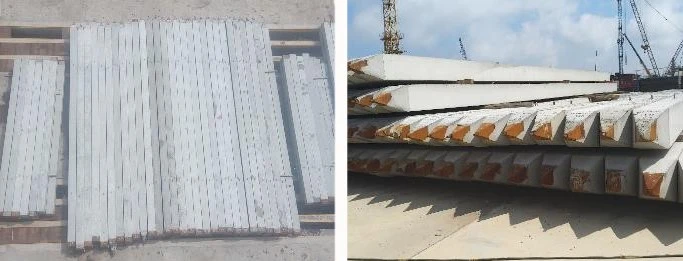
Program Comparison
1. Concrete bottom mould: For a long time, concrete bottom mould has been used for square piles in order to save cost. However, the appearance quality of precast square piles produced by using a concrete bottom mould is poor.
2. Adopt steel bottom mould: When the bottom mould of the precast square pile adopts traditional steel bottom mould, the reinforcement process of square pile formwork is cumbersome, and the bottom mould of the square pile needs to be modified when the cross-sectional size of the square pile changes.
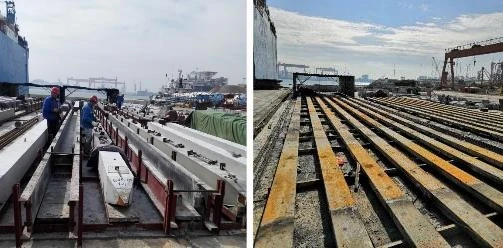
3. Bottom formwork adopts formwork table combined with formwork magnet: The bottom formwork of square pile adopts the combination of formwork magnet and formwork table, which is not only able to adapt to various sizes of square piles but also greatly simplifies the installation process of the formwork of the square pile through the cooperation of precast concrete magnet and formwork table.
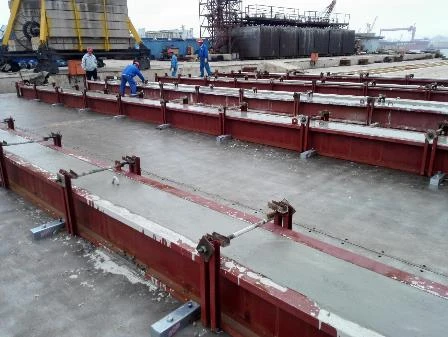
Advantages compared with the traditional process
1. Convenient disassembly and installation, saving time and labour: the traditional bolt fixing method is difficult, time-consuming and laborious to disassemble and install; while the use of formwork magnets makes it easy and convenient to disassemble and install.
2. Various application scenarios: precast concrete magnets can be used for wood, aluminium, steel moulds and any combination of them; traditional bolt or threaded fixing methods often need to be changed frequently according to the type of moulds.
3. Protecting moulds and formwork tables: The strong magnetic core adsorbs the formwork tables to fix the moulds without drilling holes in the moulds or formwork tables, which will not cause any damage to the formwork tables and moulds, and greatly improves their service life. The traditional method, on the other hand, requires drilling holes in the mould or the formwork table and then bolting it in place, which can cause permanent damage, and over time can also lead to uneven surfaces on the members, the shorter service life of the mould and the formwork table, and higher cost amortization.
By comparing the above options, the bottom mould for the square piles in this project was constructed using a steel formwork table combined with formwork magnets.


