


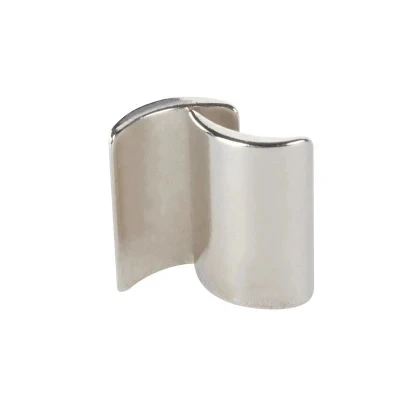
First. Shape and application of magnets in motors
In the manufacturing field of various types of motors, the shape of the magnet is closely related to the application. Generally speaking, the common motor magnets are mostly tile-shaped, this shape can be well adapted to most of the internal structure of the motor design, especially in the permanent magnet synchronous motor, tile-shaped magnets can be accurately arranged on the surface of the rotor, through the clever way of magnetization, so that the motor in the process of operation to achieve high efficiency of energy conversion. Meanwhile, round magnets are commonly used in some small motors with special space layout requirements, such as common toy motors, whose compact structure with round magnets can meet the needs of low cost and small size, and ensure stable operation of the motor. Trapezoidal magnets play a key role in some specially designed linear motors, and their unique shape helps to realise the uniform magnetic field distribution required for linear motion, ensuring the smoothness and precision of motor operation.
Because different types of motors have different operating principles and performance requirements, this determines the shape of the magnets used. Permanent magnet motors rely on permanent magnets to generate a constant magnetic field, providing a stable magnetic base for motor operation; AC and DC motors in the process of operation, according to the changes in the direction of the current, the magnets need to be able to flexibly adapt to the different magnetic field changes, a specific shape of the magnets can effectively meet this demand; linear motors through the role of the magnetic field to realise the straight line reciprocating motion, the shape and layout of the magnet directly affect the precision of its movement and the size of the thrust; Brushless motors achieve high efficiency and low noise operation by the cooperation between magnets and electronic commutators, and the appropriate magnet shape is one of the key factors to guarantee its performance.
Motor magnets are usually driven using their attractive and repulsive forces, typically using radially symmetrical magnetized tile-shaped magnets to form a ring. This ring structure can form a uniform and stable magnetic field inside the motor, which greatly improves the operating efficiency and stability of the motor. For example, in the drive motor of electric vehicles, this ring structure composed of radially symmetric magnetized tile-shaped magnets can provide strong and stable power output for the motor, ensuring that the vehicle can maintain good performance under different driving conditions.
Second.Characteristics and problems of sintered NdFeB magnets
Sintered NdFeB, a kind of magnetic material with excellent performance, is widely used in the field of electric motors. However, due to its anisotropic material properties, making complex magnetization directions faces many challenges. The directionality of its atomic arrangement makes it necessary to precisely control the process parameters when performing complex magnetization operations, otherwise, it is difficult to achieve the desired magnetic properties.
Currently, although there are also sintered NdFeB radioactively magnetized magnets, there are many limitations in practical applications. In terms of size, due to the specificity of the magnetization process, the size range of magnets that can be produced is relatively narrow, which is undoubtedly a major obstacle for some of the special motor application scenarios that require large magnets. In terms of brand, not many manufacturers have mastered the mature and high-quality radioactive magnetizing technology, which leads to a limited number of high-quality products available on the market.
In addition, the magnetic properties of these magnets are extremely unstable and are greatly affected by factors such as ambient temperature and humidity. In a high-temperature environment, its magnetic properties will show a significant decline, thus affecting the overall performance of the motor. Moreover, its consistency is very poor, different batches of magnets in the production of magnetic properties may be large differences, for the large-scale production of electric motors and the requirement of a high degree of consistency in the performance of the product for the enterprise, increasing the difficulty of production management and quality control. Furthermore, the cost of mould coils and magnetizing fixtures used to produce these magnets is very high, which undoubtedly increases the production cost of motors significantly and limits their promotion in some cost-sensitive applications.
Third, the generation and interaction of magnetic fields in motors
The generation and interaction of magnetic fields are the core elements in the operation mechanism of a motor. When the coil in the motor is energized, a magnetic field is generated, at which time the energized coil is like an electromagnet. The positive and negative poles of the magnet and the same pole of the electromagnet will produce repulsion and attraction, and this interaction force is the fundamental source of power to drive the motor rotor rotation.
For example, in a DC motor, the brushes and commutator constantly switch the direction of the current, causing continuous attraction and repulsion between the poles of the electromagnet and the poles of the permanent magnets (i.e., the magnets in the motor), which drives the rotor to rotate continuously. If there is no magnet in the motor, the current coil will not be able to be acted upon by sufficient external force, and the motor will not be able to achieve rotation. This is like a car without an engine, which can not generate power to drive the vehicle forward, the magnet for the motor, is to ensure the normal operation of the indispensable key components.
Fourth, the choice of different types of motor magnets
As the magnet is the core component of the entire motor machinery, its performance and characteristics directly determine the performance of the motor. In the motor manufacturing industry, different types of motors according to their own performance needs, will choose different types of magnets.
In the vast majority of large and medium-sized motors, NdFeB magnets have become the preferred material because of their high remanent magnetization, high coercivity high magnetic energy product and other excellent properties. In large drive motors in the industrial field, NdFeB magnets can provide a strong magnetic field for the motor to ensure that the motor still maintains efficient and stable operation under high loads and prolonged operation, which meets the stringent requirements of industrial production for the performance of motors.
For some special-purpose motors, such as in the aerospace field, due to the extreme complexity of the working environment, the motor's high-temperature resistance, radiation resistance and other performance requirements are extremely high, at this time, samarium cobalt magnets stand out because of its good high-temperature stability and radiation resistance. Although the cost of samarium cobalt magnets is high, its advantages are fully realized in this special scenario where the performance requirements are extremely harsh.
For some motors with lower performance requirements, such as common household appliance motors, ferrite tiles are widely used due to their low cost and abundant raw materials. Although the magnetic properties of ferrite tiles are relatively weak, they are cost-effective in meeting the motor-driving needs of general household appliances.
The electric rotor of an ordinary motor generally consists of nickel-plated or epoxy resin neodymium-iron-boron magnets with an average temperature resistance of about 120°C, which can meet the usage requirements in general industrial and civil environments. Ferrite and samarium cobalt have a high-temperature resistance of about 400°C, which is suitable for some motors working in high-temperature environments. However, relatively speaking, NdFeB is better than SmCo and Ferrite in terms of magnetic properties, such as remanent magnetization, coercivity and other key indexes, in addition to lower temperature resistance. This also explains why NdFeB magnets are widely used in application scenarios that do not require high temperature but high magnetic properties.


