


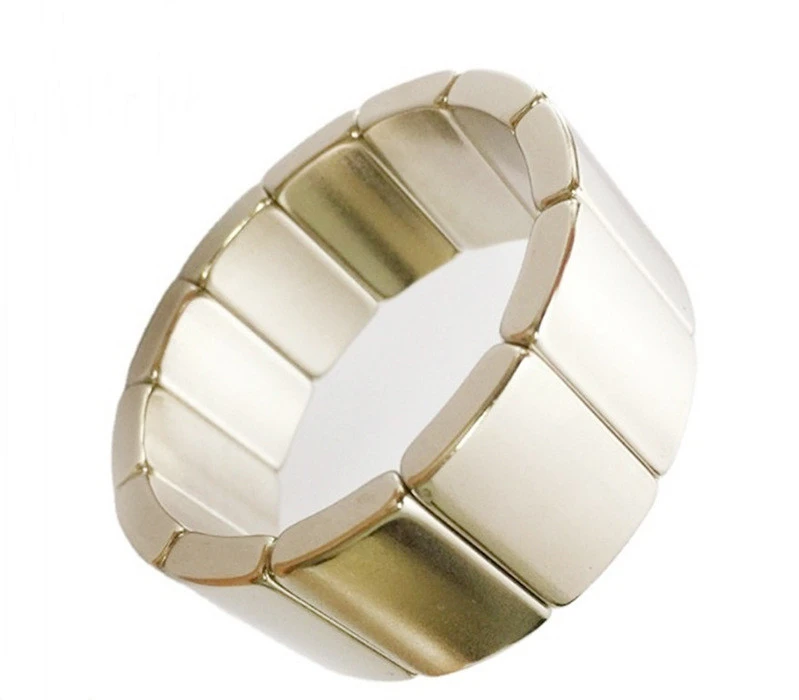
Now the magnetic material used in the motor is mainly NdFeb such as strong magnetic, but also sintered or bonded (injection molding) NdFeb. If NdFeb is used as motor magnet, the size of permanent magnet motor is relatively small, and light, the corresponding high servo system, high power and speed/weight ratio, high starting torque, more power saving. Of course, some will choose to use samarium cobalt or ferrite as motor magnets.
Most of the magnets used in general motors choose tile magnets, but also a circular or trapezoidal, for different motors, so the shape of the motor is not the same. For example, permanent magnet motors may communicate with DC motors, linear motors, brushless motors, etc. People generally use motor magnet and motor magnet attraction and repulsive force to drive, under normal circumstances will use radial symmetric magnetizing tile to form a ring. Sintered NdFeb is anisotropic material, so it will be more difficult to make complex magnetization direction. At present, there are also sintered NdFeb magnetic radiating magnet, but there are many constraints on scale and trademark, and its magnetic function is extremely unstable, the consistency is very poor, and the mold coil and the magnetizing fixture are very expensive. In the motor, the magnetic field occurs after the coil is energized, and the energized wire coil is also called electromagnet. The positive and negative poles of the magnet will repel and attract the same poles of the electromagnet. So the magnet is needed, otherwise if the current coil is not stressed, the motor will not rotate. Because the magnet is the core part of the whole machinery, so in the motor, the vast majority of the large and medium motor will use NdFeb, there are also some special use of samarium cobalt magnet, some other motor with low functional requirements will also use ferrite magnetic tile. Normal electric rotor motor is composed of nickel plated or epoxy resin ndFeb magnets, the average temperature resistance is about 120°C, and ferrite and samarium cobalt can reach high temperature resistance of about 400°C, but relatively NdFeb in addition to the lack of high temperature resistance, all aspects are still more excellent than samarium cobalt and ferrite.


