


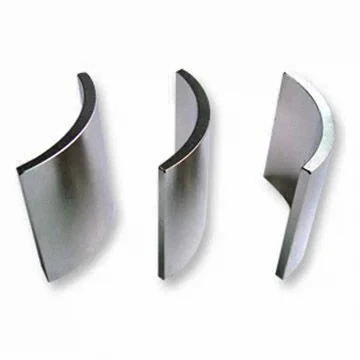
Magnets play a crucial role in the operation of motors, and one of the most commonly seen types in motors is the "tile-shaped magnet".
Tile-shaped magnets get their name because their shape closely resembles that of tiles. They are also known as arc-shaped magnets or curved-shaped magnets. Their unique shape allows for efficient interaction with the magnetic fields generated within motors. When electricity passes through the coils of a motor, a magnetic field is created. The tile-shaped magnets, with their carefully designed shape, can effectively interact with this magnetic field, either attracting or repelling it. This interaction is what drives the rotation of the motor's shaft, converting electrical energy into mechanical energy.
These magnets are not only used in motors but also find applications in generators. In generators, the process is reversed. Mechanical energy is used to rotate the shaft, which in turn causes the tile-shaped magnets to move within a coil of wire. According to Faraday's law of electromagnetic induction, this movement induces an electric current in the wire, thus generating electricity.
In addition to motors and generators, tile-shaped magnets are used in some pumps. For example, in magnetic drive pumps, these magnets help transfer rotational force without the need for a direct mechanical connection. This is extremely useful in applications where a leak-free operation is essential, such as in the transfer of hazardous chemicals. The magnets enable the pump to operate smoothly and efficiently while maintaining a sealed environment.
They can also be found in certain sensors within motors. These sensors rely on the magnetic properties of the tile-shaped magnets to detect the position or speed of the motor's moving parts. By monitoring the changes in the magnetic field, the sensor can send signals to a control system, which helps in regulating the motor's performance. This is crucial for ensuring the motor operates at optimal efficiency and prevents overheating or other malfunctions.
When comparing different types of magnets used in motors, such as neodymium magnets, ferrite magnets, and samarium-cobalt magnets, tile-shaped magnets have their own set of advantages. Neodymium magnets are known for their strong magnetic fields, but they may be more expensive and less resistant to high temperatures. Ferrite magnets, on the other hand, are more affordable but have relatively weaker magnetic fields. Tile-shaped magnets, often made from materials like these, offer a balance between cost, performance, and durability depending on the specific requirements of the motor application.
Tile-shaped magnets are an essential component in many electrical and mechanical devices. Their unique shape, magnetic properties, and versatility make them ideal for use in motors, generators, pumps, and sensors. As technology continues to advance, we can expect to see even more innovative applications of these magnets, further improving the efficiency and performance of various devices in our daily lives.


