An axisymmetric magnet (such as a cylindrical rod) generates an axisymmetric magnetic field. Can the magnetic field be used to determine whether the magnet is rotating as a whole?
The answer is not straightforward. Faraday conducted experiments related to this concept, and his results were later a subject of extensive debate as the understanding of electromagnetism evolved. This experiment, known as the "Faraday paradoxical experiment," had a relatively simple setup. It consisted of a cylindrical permanent magnet, a disc-shaped conductor mounted on a rotating shaft, metal brushes for electrical contact, a shaft conductor to complete the electrical path, a support frame conductor, and a galvanometer to detect the induced current. The cylindrical magnet and the disc-shaped conductor were installed on their respective rotating shafts and could rotate independently around the axis. This device is also called the Faraday disc generator, as shown in the figure below:
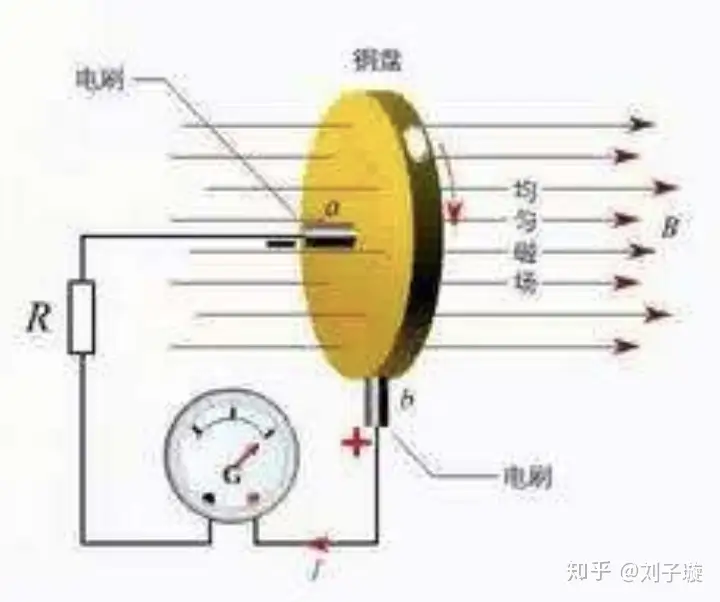
The Faraday disc generator schematic experiment was carried out in three parts:
1. When only the disc rotates and the magnet is fixed, a current is detected in the disc, and it is proportional to the speed of the disc. This is in line with the principle of an electrical generator, which is the origin of the name of the disc generator.
2. When the disc is fixed and the magnet rotates, no current can be detected in the disc.
3. When the disc and magnet rotate at the same angular speed, a current is detected in the disc, and like in case 1, the current is proportional to the rotational speed.
At first glance, it might seem that cases 1 and 2 should be equivalent. In case 1, with a fixed magnet and a rotating disc, current is detected as the disc cuts the magnetic field lines. However, in case 2, with a fixed disc and a rotating magnet, no current is detected. Although it might seem intuitive that by choosing the disc as a reference frame, case 2 should be equivalent to case 1, this is not the case in classical electromagnetism. When considering the fundamental laws of electromagnetic induction, the magnetic field and its interaction with the conductor are not symmetric in this way. Case 3 also seems counter-intuitive, as there is no relative speed between the disc and the magnet, yet an induced current is produced. This is the "paradox" of this experiment.
Faraday explained that the magnet's magnetic field lines were not "rigid" and did not rotate with the magnet. He used an analogy to describe how the magnetic field lines remained, in a sense, "stationary" relative to space, similar to how the direction of water flow from a pipe remains the same even if the pipe moves. While this explanation was a remarkable attempt at the time, as our understanding of electromagnetism advanced, we realized that it was an incomplete picture.
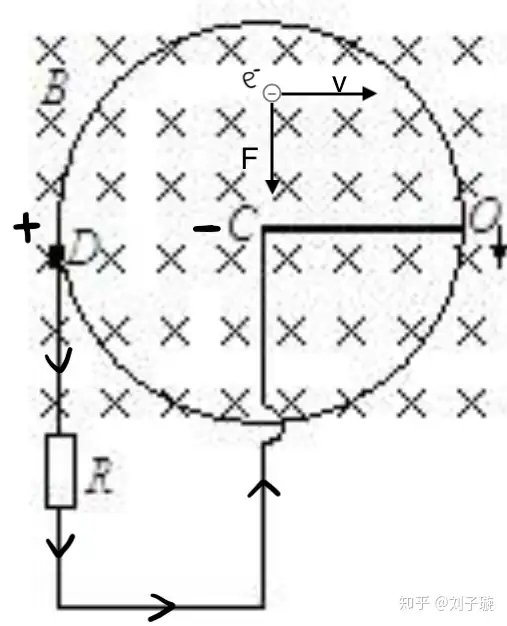
It was not until the discovery of the Lorentz force and the establishment of Maxwell's equations that people began to view electromagnetic phenomena from a field-theoretic perspective. Feynman's explanation of the "Faraday paradoxical experiment" offers a more in-depth and fundamental understanding. While cutting magnetic field lines can provide an initial understanding of the Faraday disk generator, Feynman's approach using the Lorentz force and Maxwell's equations is more comprehensive. When the magnet is stationary and the disk rotates, the free electrons in the rotating disk experience a radial Lorentz force due to their motion in the magnetic field. This causes a radial charge separation, generating an induced electromotive force in the radial direction. When only the magnet rotates, since the magnetic field is axisymmetric, its rotation does not produce a change in the magnetic field that would induce an electric field in the stationary disk, and thus no current is generated.
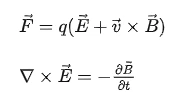
The Faraday disc generator principle reveals much about the "Faraday paradoxical experiment." It encourages us to view electromagnetic problems from a field-theoretic perspective. In this view, the field is described by its spatial distribution and time - variation, without relying on the concepts of the speed or angular velocity of a general object. While the magnetic field of a uniformly rotating axisymmetric magnet rod does not change in a way that can be easily detected as a time-varying magnetic field in the far-field region, it is possible to detect the rotation of the magnet through its interaction with conductors. For example, by placing induction coils around the rotating magnet, the changing magnetic flux due to the magnet's rotation can induce currents in the coils, which can be measured.