


Definition and Core Function
Electromagnetic Filter is a kind of intelligent filtration equipment that utilizes the magnetic field effect to remove ferromagnetic impurities (such as iron powder and metal debris) from liquid. It realizes the cyclic purification process of "adsorption-desorption-flushing" through the precise control of the electromagnetic field. It is widely used in industrial scenarios such as iron and steel rolling, metal processing, electroplating, etc., which can effectively protect the equipment and improve the quality of products.
Working Principle: Intelligent Cycle Controlled by Magnetic Force
1. Magnetization adsorption stage
When the liquid to be filtered flows through the equipment, the external electromagnetic coil is energized to generate a strong magnetic field (up to 1.2-1.5 Tesla), which instantly magnetizes the magnetic materials (steel wool or magnetic balls) filled inside. These activated magnetic materials will act like magnets to capture the iron particles in the liquid, and the filtration precision can reach 5-50 microns.
2. Demagnetization flushing stage
After completing the filtration cycle, the electromagnetic coil is de-energized and the magnetism of the filling material disappears immediately. At this time with 60-80 ℃ hot water reverse flushing, can be adsorbed impurities quickly flushed into the sludge tank, the whole process without replacing the cartridge, to achieve automated cleaning.
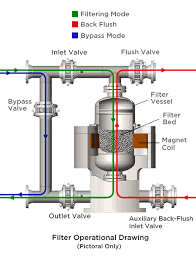
Technical evolution: comparison of the two mainstream structures
Packed electromagnetic filter (steel wool type)
●Structural features
Filled with high-density stainless steel fibers (similar to steel wool), with a specific surface area of 8000 m²/m³.
●Technical Advantages
○Ultra-high adsorption capacity: can capture iron powder 3 times its weight in a single pass.
○ Suitable for fine filtration: removes particles with a particle size of >5μm.
○ Typical application: cold mill emulsion system
Magnetic Ball Electromagnetic Filter (upgraded version)
● Innovative design
Adopting spherical magnetic media with a diameter of 3-5mm, arranged to form a three-dimensional filtration bed.
● Breakthrough Improvements
○ 40% increase in flushing efficiency: the gap between the spheres facilitates the discharge of impurities.
○ 3 times longer maintenance intervals: no fiber entanglement problems
○ Increased flow rate: 200m³/h, suitable for large circulating systems.
○Typical application: galvanizing line circulation tanks
Analysis of six core advantages
| Performance Indicators Technical Value | Technical Value |
| Zero consumable costs | Saves $15,000 per year in maintenance costs compared to conventional filter bags. |
| Energy Efficiency | Intermittent mode of operation with 70% lower energy consumption |
| Processing Capability | Single machine processing 200 tons of emulsion per hour (rolling mill measured data) |
| Water Quality Enhancement | Iron powder concentration reduced from 500ppm to <10ppm |
| Degree Of Automation | PLC control, support IOT remote monitoring |
| Environmental benefits | Reduce sludge production by 90% |
In-depth analysis of industrial application scenarios
1. Cold rolling mill emulsion system
● Problem pain point: A large amount of iron powder (0.1-2mm) is generated during the rolling process, resulting in:
○ Scratches on the roll surface
○ Accelerated lubricant failure
○ Decrease in product surface finish
● Solution: Install a magnetic ball filter in the circulating pipeline to realize:
○ Iron powder removal rate ≥98%
○ Extension of roll life by 30%.
○ Reduction of steel plate surface defect rate by 75%.
2. Continuous plating production line
● Application value:
○ Removal of magnetic particles in the plating solution to avoid plating layer pockmarks
○ Stabilization of zinc/tin ion concentration
○ Typical parameters:
-Processing flow rate: 80m³/h
-Working pressure: 0.6MPa
-Filtration precision: 15μm
3. Machining coolant recovery
● Economic benefits:
○ Extend the service life of coolant by 5-8 times.
○ Reduce annual disposal cost by $8,000 per machine tool
○ Compliance with OSHA Occupational Health Standards
Selection Guide: Key Parameter Comparison Table
| Parameters | Packing type | Magnetic Ball Type |
| Applicable particle size |
>5μm |
>20μm |
| Maximum working pressure |
1.0MPa |
1.6MPa |
| Backwash water consumption |
0.8m³/cycle |
0.3m³/cycle |
| Media Replacement Cycle | 2 years | 5 years |
| Initial investment cost |
$12,000 |
$18,000 |
| Typical payback period | 8 months | 14 months |
Maintenance optimization recommendations
1. Magnetic field strength calibration: monthly testing with a Gaussmeter, deviation >15% need to check the coil
2. Temperature monitoring: keep the flushing water temperature at 70±5℃ to prevent media scaling.
3. Flow matching: the actual flow should be controlled at 70-90% of the rated value
4. Sludge treatment: It is recommended to configure a centrifugal dewatering machine to reduce the water content from 95% to 60%.
Technology Development Trends
● Intelligent sensing integration: real-time monitoring of iron powder concentration and automatic adjustment of the work cycle
● Superconducting magnet application: Increase the magnetic field strength to 3T and capture nanoscale particles.
● Modular design: Plug-and-play quick changeover
● Green Process: Developing Biodegradable Magnetic Media
According to the Society of Manufacturing Engineers (SME), smart electromagnetic filters are predicted to capture 32% of the industrial filtration market by 2028. For companies in metalworking and automotive manufacturing, adopting this type of equipment not only improves product quality but is also an important technological path to sustainable production.


