


How are metal magnetic materials divided?
Metal magnetic materials are divided into two categories: permanent magnet materials and soft magnetic materials. Generally, materials with an internal coercivity greater than 0.8kA/m are called permanent magnet materials, and materials with an internal coercivity force of less than 0.8kA/m are called soft magnetic materials.
The magnetic force of several types of commonly used magnets is arranged from large to small: NdFeB magnets, samarium cobalt magnets, Alnico magnets, ferrite magnets.
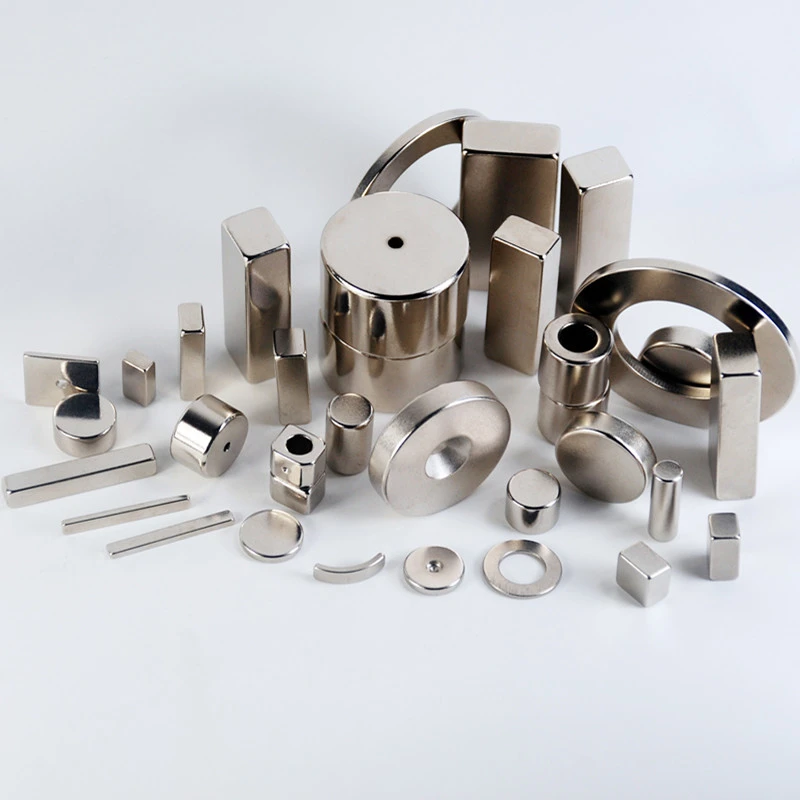
Performance-price analogy of different magnetic materials?
Ferrite: low and medium performance, lowest price, good temperature characteristics, corrosion resistance, good performance-price ratio
NdFeB: the highest performance, medium price, good strength, not resistant to high temperature and corrosion samarium cobalt: high performance, highest price, brittle, excellent temperature characteristics, corrosion resistant Alnico cobalt: low and medium performance, medium price, excellent temperature characteristics, corrosion resistance, poor interference resistance Samarium cobalt, ferrite, NdFeB can be manufactured by sintering and bonding methods, high sintering magnetic properties, poor molding, good formability of bonded magnets, much lower performance. AlNiCo can be manufactured by casting and sintering methods, casting magnets have higher performance and poor formability, and sintered magnets are lower and have better formability.
| Item comparison | Injection molded ferrite | Sintered ferrite |
| Shape | Multiple complexity | Simple corner slotting and punching machining |
| Size and precision | High;+0.08 | Low;+0.1 |
|
Drop and wear resistance |
High | Low |
| Magnetic force | Low | High |
| Temperature resistance | Low | High |
Features of NdFeB magnets
NdFeB permanent magnet materials are permanent magnet materials based on the intermetallic compound Nd2Fe14B. NdFeB has a very high magnetic energy product and coercivity, and the advantages of high energy density make NdFeB permanent magnet materials widely used in modern industry and electronic technology, so that instrumentation, electroacoustic motors, magnetic separation magnetization and other equipment miniaturization, lightweight, thinning is possible.
Material characteristics: the advantages of NdFeB are high cost performance and good mechanical properties; The disadvantage is that the Curie temperature point is low, the temperature characteristics are poor, and it is easy to pulverize and corrode, and it must be improved by adjusting its chemical composition and adopting surface treatment methods to meet the requirements of practical applications.
Manufacturing process: The manufacture of NdFeB adopts powder metallurgy process. Process flow: Batching → smelting ingots→ milling → pressing → sintering and tempering → magnetic detection → grinding → pin cutting processing → electroplating → finished products.
Features of ferrite magnets
Its main raw materials include BaFe12O19 and SrFe12O19. Manufactured by ceramic process, the texture is relatively hard, is a brittle material, because ferrite magnets have good temperature resistance, low price, moderate performance, has become the most widely used permanent magnet.
Characteristics: It has high magnetic properties, good time stability and low temperature coefficient.
Ferrite magnet application places: widely used in electricity meters, meters, motors, automatic control, microwave devices, radar and medical equipment. Ferrite magnet magnetization direction: can be axial, radial or as required.
Ferrite magnet shape: can produce cylindrical, toroidal, cuboidal, flat, tile, axe.


