


Introduction
Magnetic lifters are indispensable tools in heavy industries, enabling efficient handling of ferrous materials like steel plates, coils, and machinery parts. Unlike traditional mechanical clamps, these devices use controlled magnetic fields to securely lift loads without surface damage. This article explores their working principles, types, and critical applications while addressing industry-specific safety standards.
How Magnetic Lifters Work: Core Principles
Magnetic lifters operate through three distinct technologies, each tailored to specific industrial needs:
1. Electromagnetic Lifters
Mechanism: A coil wrapped around a ferromagnetic core (e.g., laminated iron) generates a magnetic field when energized by direct current (DC).
Key Feature: Instant on/off control via power supply; ideal for high-frequency operations.
Safety Note: Requires backup power systems to prevent load drops during outages.
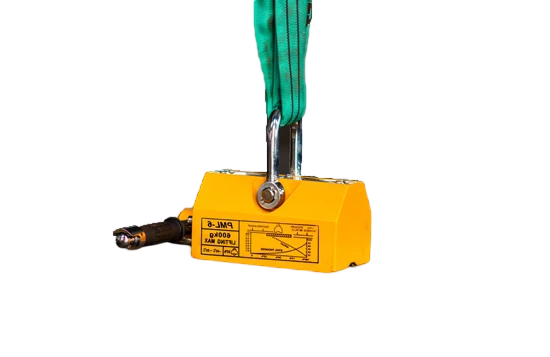
2.Permanent Magnet Lifters
Mechanism: High-grade rare-earth magnets (e.g., neodymium) create a persistent magnetic field. Manual levers redirect internal magnetic flux to engage/disengage lifting.
Key Feature: Zero energy consumption; ideal for hazardous or remote environments.
3. Electro-Permanent Magnet (EPM) Lifters
Hybrid Design: Combines permanent magnets with electromagnetic pulses. A brief current pulse (<100 ms) reorients the magnetic circuit, locking or releasing the load.
Key Feature: Fail-safe operation loads remain secure even during power failures.
Critical Technical Insight:
Magnetic adhesion depends on surface contact quality. For optimal performance, ensure lifted materials are flat, clean, and free of rust/paint. Industry standards like OSHA 1926.1431 mandate routine inspections of magnetic strength and core integrity.
Types of Magnetic Lifters: Choosing the Right Solution
|
Type |
Best For |
Load Capacity |
Energy Source |
|
Manual Permanent |
Small workshops, power-free zones |
Up to 2 tons |
None |
|
Electromagnetic |
High-speed factories, foundries |
1–20 tons |
Continuous DC power |
|
Electro-Permanent (EPM) |
Shipyards, construction sites |
5–30 tons |
Intermittent pulses |
|
Battery-Powered Electros |
Remote logistics, outdoor projects |
1–10 tons |
Rechargeable batteries |
Pro Tip: EPM models dominate the U.S. market due to their energy efficiency and compliance with ANSI/ASME B30.20 safety regulations.
Industrial Applications: Where Magnetic Lifters Excel
1. Steel Production & Fabrication
Seamlessly transport hot-rolled coils (up to 600°C with ceramic-coated models).
Stack precision-cut sheets for laser/plasma cutting systems.
2. Automotive Manufacturing
Handle stamped body panels without scratching coated surfaces.
Position powertrain components (e.g., 500-lb engine blocks) on assembly lines.
3. Aerospace & Defense
Assemble titanium alloy fuselage sections with a controlled magnetic grip.
Install jet engine components in cleanroom environments.
4. Infrastructure & Construction
Erect structural steel beams at skyscraper sites.
Position rebar grids for concrete pours.
5. Scrap Recycling
Sort and load fragmented ferrous scrap using overhead EPM cranes.
Case Study: A leading automaker reduced part-handling damage by 73% after switching to EPM lifters with anti-sway sensors.
Safety & Compliance: What Users Must Know
Surface Prep: Remove oil, ice, or debris to maximize magnetic flux density (measured in Gauss).
Load Testing: Conduct daily pull tests per CMAA 70 specifications.
Temperature Limits: Standard models operate between -4°F to 158°F (-20°C to 70°C); high-temp variants are available.
Training: OSHA requires operators to complete certified magnetic handling courses.
Future Trends: Smart Magnetic Lifters
IoT Integration: Real-time load monitoring via embedded strain gauges and Bluetooth reporting.
Energy Recovery: Regenerative systems that store switching pulses in supercapacitors.
AI-Powered Control: Predictive algorithms adjust grip strength based on material thickness sensors.
Conclusion
From steel mills to wind turbine installations, magnetic lifters revolutionize material handling through precision and reliability. Selecting the appropriate type of fail-safe EPMs for offshore rigs or agile electromagnets for automated businesses achieves unmatched operational efficiency. Always partner with ISO 9001-certified manufacturers to ensure compliance and longevity.


