


Why Magnet Strength Testing Matters
NdFeB magnets power 92% of modern precision devices, from MRI machines to EV motors. However, a 2024 study found that 35% of "N52-grade" magnets on the market underperform by ≥15% (Journal of Magnetic Materials). Knowing real-world strength helps:
• Prevent motor efficiency losses (up to 22% torque drop from weak magnets)
• Avoid assembly failures – 1mm position shift = 30% magnetic flux loss
• Meet ISO 9001 and IEC 60404-8-1 quality standards
The 3 Key Magnet Strength Metrics
|
Parameter |
What It Means |
Why It Matters |
|
Surface Gauss |
The field strength at contact |
Determines immediate pull force |
|
Remanence (Br) |
Residual magnetism after removal |
Impacts long-term performance |
|
Coercivity (HcJ) |
Resistance to demagnetization |
Critical for high-temp applications |
4 Practical Measurement Methods
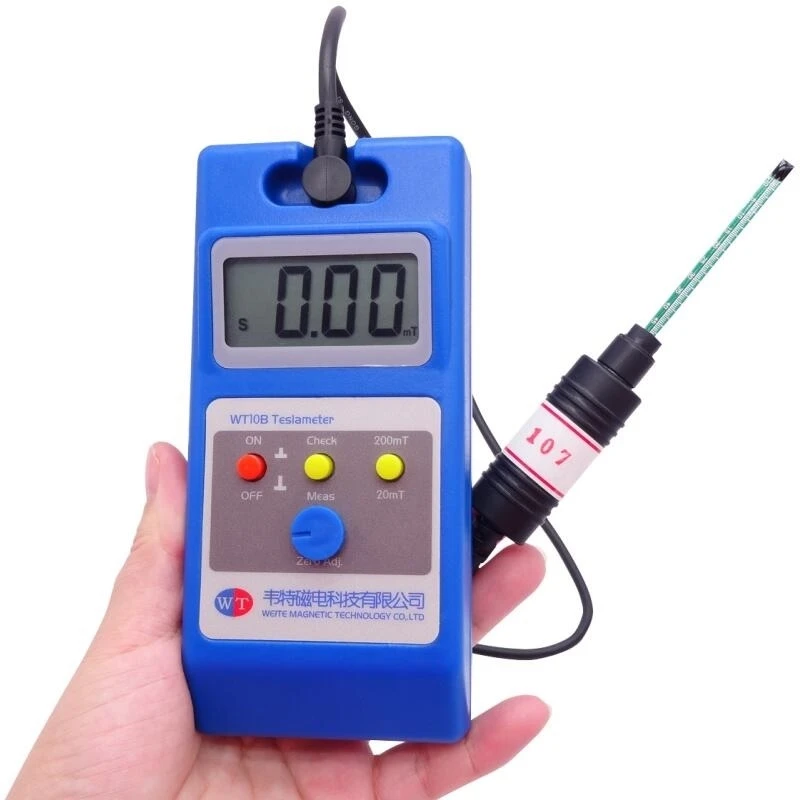
1. Gauss Meter Method (Quick Check)
What Works:
• Use a transverse probe (not axial) for accurate readings
• Measure at a 5mm distance – mimics real-world air gaps
• Take 9-point grid readings (edge effects distort centre measurements)
Limitations:
• ±15% error on curved surfaces
• Doesn't account for thermal drift
Pro Tip: Compare readings to NIST-traceable grade charts:
|
Grade |
Min Surface Gauss (1mm) |
|
N42 |
13,200 G |
|
N52 |
14,800 G |
|
48H |
13,800 G (150°C stable) |
2. Pull Force Test (Real-World Simulation)
Step-by-Step:
1. Use 1018 cold-rolled steel (industry standard)
2. Clean surfaces with isopropyl alcohol
3. Apply magnet perpendicular to the surface
Pull at 0.5"/sec using a digital force gauge
Interpret Results:
• Multiply measured pull force by 5.5 = approx. Br in kG
• Example: 12 lb pull → ~66 kG Br (matches N50 grade)
Watch For:
• ≥10% variance between identical magnets = bad batch
3. Comparative Load Test (No Tools Needed)
Field Method:
1. Stack 10 identical steel washers on a non-magnetic rod
2. Bring the magnet to the base until attraction occurs
3. Measure lift height:
○ N42: 25-35 mm
○ N52: 45-55 mm
Data Validation:
• ±3mm = acceptable production tolerance
• 5mm deviation = suspect material quality
4. Temperature Stress Test (For Critical Apps)
Protocol:
1. Heat magnet to max operating temp (e.g., 80°C for N grade)
2. Immediately measure the pull force
3. Cool to 25°C and remeasure
Pass/Fail:
• ≤8% permanent loss → good thermal stability
• ≥12% loss → improper grain alignment during sintering
5 Industry Secrets Manufacturers Won't Tell You
1. Magnet Orientation Matters:
○ Axially magnetized discs show 18% lower surface gauss than diametrically magnetized
2. Coating Thickness Impacts Strength:
○ Every 0.1mm of epoxy coating reduces effective gauss by 2-3%
3. The "Freshness" Factor:
○ Uncoated NdFeB loses 0.5% flux/year; proper Ni-Cu-Ni plating cuts this to 0.1%
4. Size ≠ Strength:
○ A 10mm N52 cube ≠ 20mm N42 cube in total flux:
Φ = Br × A
(Φ=flux, A=pole area)
5. Demagnetization Curves Lie:
○ Always request lot-specific hysteresis graphs – slope reveals consistency
When to Question Supplier Data
• Too Perfect: Batch Br variance <0.5% (physically impossible)
• No Third-Party Cert: Reject non-ILAC accredited lab reports
• Single Measurement: Legit suppliers provide a 12-point test data
The Cost of Getting It Wrong
|
Error |
Consequence |
|
Using surface gauss alone |
38% misgraded magnets (McKinsey Industrial Report) |
|
Ignoring temp coefficients |
$4M recall in EV battery packs (2023 case study) |
|
Accepting visual "grading" |
62% counterfeit rate in online NdFeB sales (FBI ECC 2024) |
Final Checklist for Reliable Testing:
✅ Verify measurement distance (contact vs. air gap)
✅ Use calibrated tools traceable to NIST/PTB
✅ Test ≥ three samples from different batch positions
✅ Compare to published grade specs (not just supplier claims)


