


Got it-let's dive deeper into the nitty-gritty of working with SmCo magnets. These aren't your average fridge magnets, folks. Their brittleness and insane magnetic strength demand surgical precision. Here's what years of hands-on experience (and a few close calls) have taught me.
Handling SmCo? Treat it like radioactive glitter.
The first rule: never underestimate their pull force. Even small SmCo magnets can generate fields strong enough to yank tools, screws, or other magnets across a workbench. Before handling, clear the area of ferromagnetic objects-yes, that includes your watch, keys, and even steel-toed boots. I once saw a wrench fly into a magnet stack-scary stuff. Use non-magnetic tools (brass or plastic) to separate magnets. And for Pete's sake, wear cut-resistant gloves. Those sharp edges can slice skin if magnets snap together.
Magnetization timing is non-negotiable.
Magnetize SmCo after assembly, period. Pre-magnetized parts will attract debris, warp positioning, or worse-shatter during fitting due to sudden impacts. Use jigs or fixtures made of non-magnetic materials (think aluminium or G10 fibreglass) to hold components in place. If you must handle magnetized parts, use magnetic shielding (mu-metal sheets) to minimize stray fields. Pro tip: Keep a demagnetizer nearby for emergencies.
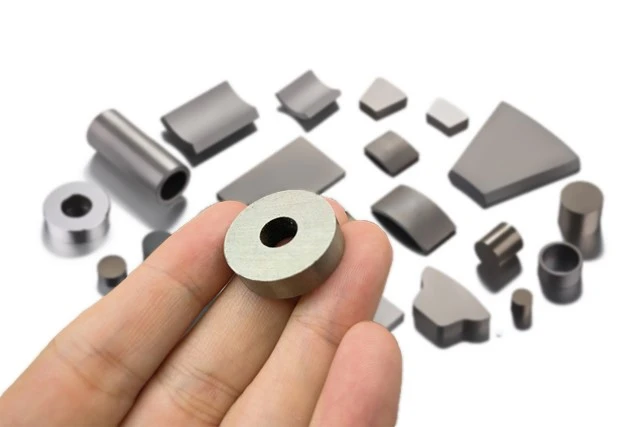
Machining SmCo? It's a high-stakes science project.
Forget lathes or milling-SmCo's brittle structure laughs at conventional cutting. Grinding is your only friend, but here's the catch: coolant flow rate matters more than your coffee intake. Use water-soluble coolants with rust inhibitors, and aim for a flow that fully submerges the grinding zone. Why? SmCo dust is pyrophoric-yes, it can spontaneously ignite if dry. I stick to diamond-coated wheels (220 grit or finer) at low RPMs (< 3,000) to avoid thermal stress cracks. Monitor wheel loading like a hawk; clogged wheels overheat and ruin surface finish.
Post-machining TLC.
After grinding, clean parts in an ultrasonic bath with non-flammable solvents (isopropyl alcohol works). Blow-dry with oil-free air to prevent corrosion. Oh, and that dust? Vacuum it up with HEPA filters-don't let it linger. SmCo particles are nasty for the lungs and electronics.
Storage & transport hacks.
Store SmCo magnets in padded, non-magnetic containers. Stack them with spacers (plastic or cardboard) to prevent accidental contact. For shipping, use double-walled boxes and label them "Fragile: Strong Magnetic Field." Trust me, delivery drivers won't appreciate a surprise magnet avalanche.
When things go sideways…
If a magnet chips or cracks during processing, stop immediately. Damaged SmCo magnets lose coercivity faster than a leaked iPhone prototype. Inspect for micro-cracks under UV light (dye penetrant helps). And if you smell burning during grinding? Kill the power, douse the area with coolant, and evacuate. Better paranoid than on fire.
Bottom line: SmCo rewards patience and punishes shortcuts. Master these details, and you'll harness their power without the drama. Stay sharp, stay safe, and keep that coolant flowing! 💥🔧


