


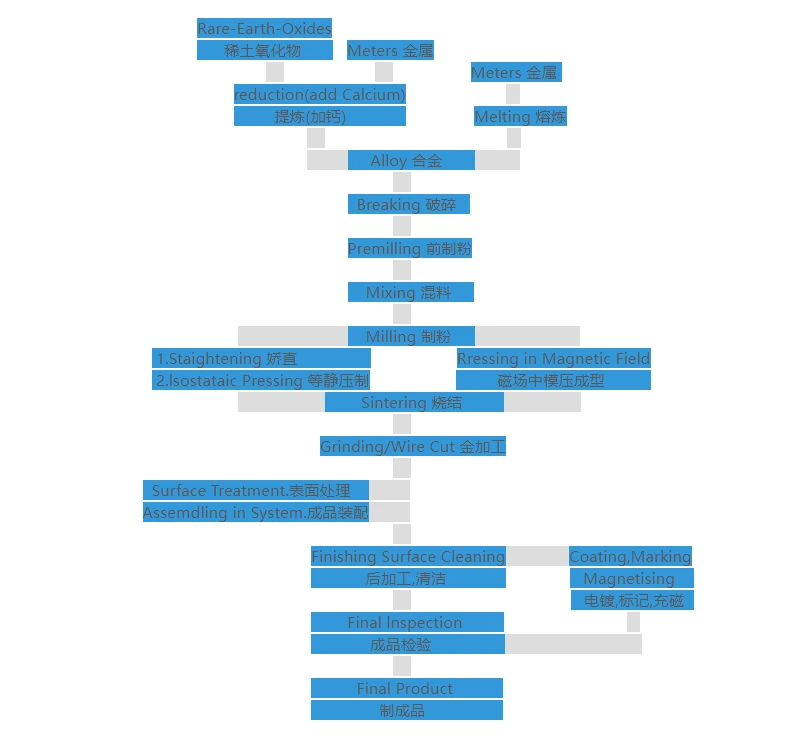
The production of magnets, especially permanent magnets like Neodymium Iron Boron (NdFeB), Samarium Cobalt (SmCo), Alnico, and Ferrite magnets, involves a series of complex steps to achieve the desired magnetic properties, shapes, and sizes. Below is an overview of the general production and manufacturing process of magnets.
1. Raw Material Preparation
Different types of magnets require specific raw materials:
NdFeB Magnets: Neodymium (Nd), Iron (Fe), and Boron (B), with additional elements like Dysprosium (Dy) or Terbium (Tb) for enhanced performance.
SmCo Magnets: Samarium (Sm) and Cobalt (Co), sometimes mixed with Iron (Fe), Copper (Cu), or Zirconium (Zr).
Alnico Magnets: Aluminum (Al), Nickel (Ni), and Cobalt (Co), often with Copper (Cu) and Iron (Fe).
Ferrite Magnets: Iron Oxide (Fe₂O₃) mixed with Barium (Ba) or Strontium (Sr).
These raw materials are precisely weighed and mixed according to specific formulations.
2. Melting and Alloy Formation
The raw materials are melted in a vacuum induction furnace at high temperatures (above 1300°C for NdFeB).
Once melted, the mixture is rapidly cooled to form an alloy.
For NdFeB, strip casting or chill block melt spinning is used to form fine metal flakes.
3. Powdering and Milling
The alloy is crushed into coarse particles and then milled into an ultra-fine powder (typically 3–5 microns in size) using jet milling or ball milling.
The smaller the particle size, the better the final magnet's properties.
4. Pressing and Shaping
Two common pressing methods are used to shape the magnetic powder:
a. Axial or Transverse Pressing in a Magnetic Field
The powdered material is compacted in a die mold while an external magnetic field aligns the particles to enhance magnetic performance.
This method is used for sintered NdFeB and SmCo magnets.
b. Isostatic Pressing
The powder is placed in a rubber mold and subjected to high pressure from all directions using water or oil.
This produces a more uniform density in the magnet.
5. Sintering and Heat Treatment
The compacted magnet blanks are heated at 1000–1200°C in a vacuum furnace.
This process removes any binder materials, fuses the particles, and increases the density and strength of the magnet.
A subsequent heat treatment (600–900°C) is performed to optimize magnetic properties.
6. Machining and Cutting
The sintered magnets are brittle and require diamond cutting tools, wire cutting, or grinding for precise shaping.
Common machining processes include:
Wire-cut EDM (Electrical Discharge Machining) for complex shapes.
Grinding for flat or smooth surfaces.
Drilling (requires special techniques as magnets are brittle).
7. Surface Coating & Plating
Some magnets, especially NdFeB, are prone to oxidation and require protective coatings:
Nickel (Ni), Zinc (Zn), Epoxy, or Gold plating to prevent corrosion.
Ferrite magnets generally do not need coating due to their high corrosion resistance.
8. Magnetization Process
The magnets are placed in a strong external magnetic field (2-5 Tesla) using pulsed electromagnetic coils.
The orientation of the magnetic domains is fixed, creating a permanent magnet.
Different magnetization patterns (axial, radial, multi-pole) can be applied depending on the application.
9. Quality Inspection & Testing
Each magnet undergoes strict quality control measures:
Dimensional Accuracy: Checked using calipers and coordinate measuring machines (CMM).
Magnetic Performance: Tested with Gauss meters, flux meters, and hysteresis graphs.
Coating Adhesion & Corrosion Resistance: Conducted via salt spray testing (ASTM B117).
Mechanical Strength & Durability Tests: Drop tests, vibration tests, and temperature cycling tests.
10. Packaging & Shipment
Magnets are carefully packaged with shielding materials to prevent accidental attraction.
They are shipped in compliance with international transportation regulations for magnets.
Conclusion
The production and manufacturing of magnets involve complex metallurgical and precision engineering processes to achieve high-performance permanent magnets. Each step, from raw material preparation to final magnetization, plays a crucial role in ensuring the quality, durability, and efficiency of the magnet.
For custom magnet manufacturing and bulk orders, feel free to contact our factory for expert consultation and high-quality solutions!


