


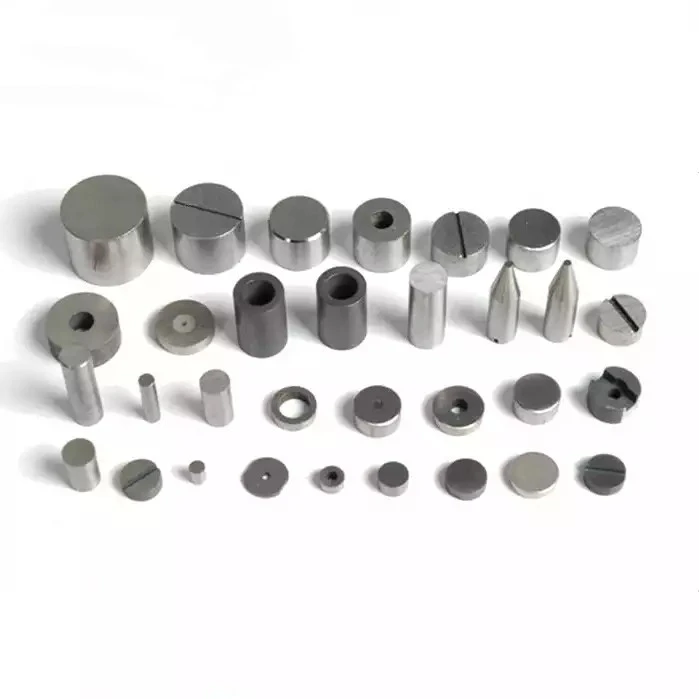
Aluminium cobalt magnet occupies an important position in the development history of permanent magnetic materials. As one of the earliest permanent magnets developed, it has left a colourful mark in many fields with its unique properties.
I. Composition and History
Aluminium-cobalt magnet is a kind of alloy composed of aluminium, nickel, cobalt, iron and other elements. As early as the 1930s, it was successfully developed, starting its brilliant decades-long application in the industrial field.
Ⅱ.Characteristics
1. High remanent magnetism: Aluminum-cobalt magnets have high remanent magnetism, up to 1.35 T. This means that after the withdrawal of the external magnetic field, it can retain strong magnetism, providing a reliable source of magnetic force for equipment that requires a stable magnetic field.
2. Low-temperature coefficient: It has a low-temperature coefficient, e.g. when the temperature coefficient is -0.02%/°C, the maximum operating temperature is about 520°C. This characteristic allows Aluminum Cobalt magnets to be used in a wide range of applications. This characteristic makes Aluminum Cobalt magnets still maintain more stable magnetic properties in environments with large temperature variations, which greatly expands their application scenarios.
3. Unique processing characteristics: according to the production process, aluminium cobalt magnets can be divided into sintered alnico and cast alnico. Casting parts can be flexibly processed into various sizes and shapes to meet diversified design requirements. Although sintered products are usually smaller in size, with larger dimensional tolerances of blanks than cast blanks, and slightly lower magnetic energy than castings, their machinability is superior, and they have a unique advantage in some cases where there are special requirements for machining accuracy and complex shapes.
4. Low reversible temperature coefficient: In the family of permanent magnets, the reversible temperature coefficient of aluminum-cobalt magnets is low, and the working temperature can reach over 600℃. This means it in the high-temperature environment, can still maintain relatively stable magnetic properties, not easily due to the temperature rise and leading to a substantial decline in magnetic properties.
Ⅲ.Advantages
1. Stable magnetic properties: the combination of high remanence and low-temperature coefficient and other characteristics, aluminium cobalt magnets can provide a stable magnetic field in different environmental conditions, to ensure the stability and reliability of equipment operation. In precision instrumentation, a stable magnetic field is essential to ensure the accuracy of measurement, so aluminium cobalt magnets have become the ideal choice.
2. Good processing adaptability: Whether it is the flexibility of the casting process, or the sintering process of good processing, aluminium cobalt magnets can adapt to a variety of complex design and manufacturing requirements, to meet the diversified product needs of different industries.
Ⅳ.The application field
In the past, aluminium cobalt magnets have been widely used in many industrial and consumer products due to their outstanding performance. For example, electric motors, provide a reliable magnetic field for the stable operation of the motor; electric guitar pickups use their magnetism to convert the vibration of the strings into electrical signals, which gives the electric guitar its unique tone; in audio equipment such as microphones, sensors, and loudspeakers, aluminium-cobalt magnets also play a key role in ensuring that the sound is accurately captured and restored. In addition, aluminium-cobalt magnets can also be found in some special areas, such as travelling wave tubes and magnets for cattle.
However, with the rapid development of technology, ferrite permanent magnets and rare earth permanent magnets were introduced after the 1960s. Rare earth magnets with stronger magnetic field (Br) and higher maximum magnetic energy product (BHmax), gradually replaced Alnico permanent magnets in many areas, making Alnico permanent magnets in the motor and other areas of the proportion of the gradual decline. However, this does not mean that Alnico magnets have lost their value. In specific scenarios where the requirements for temperature stability are extremely high and the requirements for magnetic field strength are relatively less demanding, Alnico magnets still have an irreplaceable position.


