


Do you remember the magical experience of your first encounter with magnets in your childhood? When two magnets were attracted to each other across the textbooks, this invisible power had fascinated countless children. As one of the earliest physical phenomena utilized by mankind, magnet manufacturing technology has undergone a leapfrog development from natural magnets to modern permanent magnet materials. In this article, we will take you to understand the mystery of manufacturing industrial grade permanent magnets.
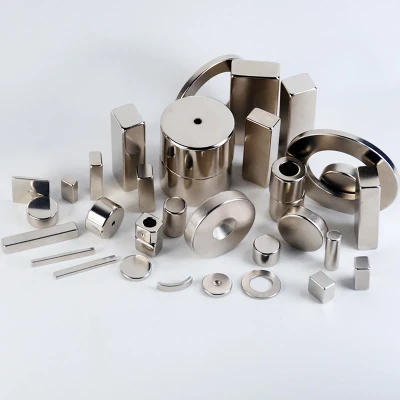
Modern permanent magnets are divided into four main categories: neodymium-iron-boron (NdFeB) rare-earth permanent magnets, ferrite permanent magnets, aluminium-nickel-cobalt alloys and rubber magnets. Among them, NdFeB is widely used in new energy vehicle drive motors because it has the strongest magnetic energy product. The manufacturing process includes the following key steps:
1. Material proportioning and melting: A vacuum induction melting furnace is used to mix precisely weighed pure iron (99.9%), rare-earth metals such as neodymium (Nd) and praseodymium (Pr), as well as boron (B) elements in a specific ratio. When the temperature reaches 1500°C, the metal is completely melted into a liquid alloy. Through the fast quenching technology, the molten metal is sprayed onto the surface of the high-speed rotating copper roller, forming an amorphous thin strip with a thickness of about 0.3mm.
2. Powder metallurgy molding: The thin strip is crushed into 200 mesh (about 74μm) micro-powder and axially pressed under a pressure of 1.5 tons/cm². At this time, it is necessary to apply a 1.6T oriented magnetic field, so that the magnetic powder grains along the predetermined direction of the orderly arrangement. For complex shape magnets, injection molding process can be used to inject the magnetic powder into the mold after combining with polymer.
3. Sintering and heat treatment: Step sintering is carried out at 1080°C in an argon-protected environment for 4 hours and then slowly cooled. This process allows the material to reach a density of 7.5g/cm³ and form a stable tetragonal crystal structure. Subsequently, the microstructure is optimized by 600°C tempering treatment to enhance the coercivity.
4. Magnetization and Detection: In a pulsed magnetic field generator, an instantaneous strong magnetic field of more than 35kOe is applied to fully orient the magnetic domains. A Gaussmeter is used to detect the surface flux density of N52 grade NdFeB magnets up to 1.48 T. Finally, nickel plating or epoxy coating is performed to prevent oxidative corrosion.
It is noteworthy that the new CeCo5 permanent magnet developed by Ningbo Institute of Materials 2023 of the Chinese Academy of Sciences, which maintains 95% of its magnetic properties at a low temperature of -60°C, provides an innovative solution for polar research equipment. With the growing demand for high-end applications such as magnetic levitation trains and nuclear magnetic resonance machines, magnetic material R&D is making breakthroughs towards high heat resistance (HTS ≥ 200°C) and recyclability.
From vibrating motors for smartphones to permanent magnet generators for wind turbines, these "invisible champions" continue to drive the development of modern technology. The next time you use a wireless headset, think about the miniature magnets that contain the essence of materials science in less than 1 gram.


