


NdFeB magnets are a type of rare-earth magnet. In headphones, they are primarily used in the moving coil driver, the component responsible for converting electrical signals into sound.
Detailed Explanation:
Headphones are electroacoustic transducers that convert electrical signals into audible sounds. Most headphones employ moving coil drivers(also known as "dynamic" drivers). In such drivers, a fixed magnet assembly generates a static magnetic field. Specifically, NdFeB magnets serve as the fixed magnetic component.
Working Principle of Moving Coil Drivers:
The audio signal current passes through a voice coil suspended within the magnetic field of the permanent magnet. This current generates a varying magnetic field around the voice coil, which interacts with the static field of the permanent magnet. The resulting force causes the voice coil and its attached diaphragm to vibrate, producing sound waves.
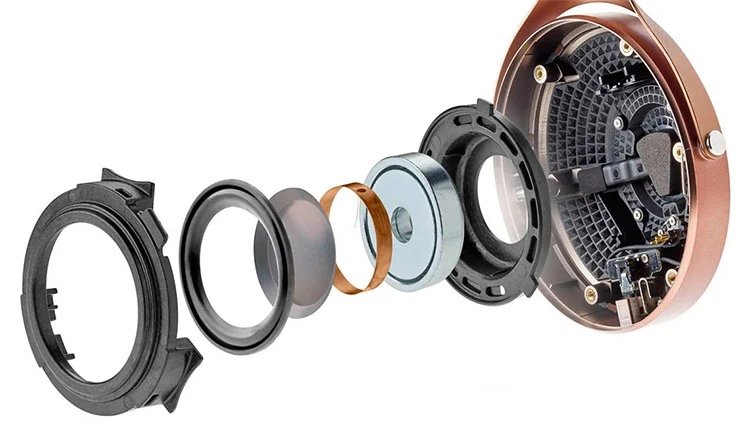
Types of Magnets Used in Headphones:
Headphone magnets are typically made of ferrite or neodymium. NdFeB magnets, a rare-earth type containing neodymium as a primary component, are one of the key magnet types used in modern headphones.
Advantages of NdFeB Magnets in Moving Coil Drivers:
Compared to alternatives like ferrite, NdFeB magnets offer higher magnetic strength while being more compact and lightweight. Driven by rising transportation costs and the demand for smaller, lighter devices, there is a growing trend toward adopting compact rare-earth magnets (e.g., neodymium and samarium-cobalt) over traditional materials.
For speaker magnetic circuits, particularly in woofers, radially or axially oriented annular NdFeB magnets enable miniaturization and compact designs. This compactness is critical for portable devices like headphones, where size and weight are key considerations. Additionally, NdFeB magnets allow small drivers (e.g., 40–50 mm diameter units in headphones) to accurately reproduce low and sub-bass frequencies.

Impact on Performance:
The magnet and its magnetic circuit design influence headphone sensitivity -the efficiency of converting electrical signals to sound. Variations in sensitivity across transducers can affect sound localization accuracy. The driver size and its low-frequency reproduction capability are also design factors indirectly tied to magnet performance, as magnetic strength governs the driving force generation.
Summary:
As a critical component in moving coil drivers, NdFeB magnets leverage their compact size, lightweight nature, and strong magnetic properties to enable efficient electroacoustic conversion. Their high performance ensures effective low-frequency reproduction even in small drivers, making them indispensable for modern headphone design.


