


The strength of a magnetic hook generally depends on its design and material. Here are some key points:
Magnetic strength
- Weight capacity: Most magnetic hangers can bear between 11 and 22 pounds, which is suitable for hanging items such as handbags and small tools. For heavier items, you may need to choose strong magnetic hooks, especially hooks made of neodymium magnets, which have stronger magnetic force and can provide higher weight capacity.
Small magnetic hooks: Suitable for hanging lighter items such as keys and towels, usually with a weight of about 11 pounds.
Heavy duty magnetic hooks: For heavier tools or items (such as gardening tools, handbags, etc.), you can choose magnetic hooks with a pull force of 22 pounds or more.
- Concentrated magnetism: The magnetic force of magnetic hanging hooks is usually concentrated on one side, and the other sides are almost non-magnetic. This design allows the hook to exert the maximum magnetic force when adsorbed on the metal surface.
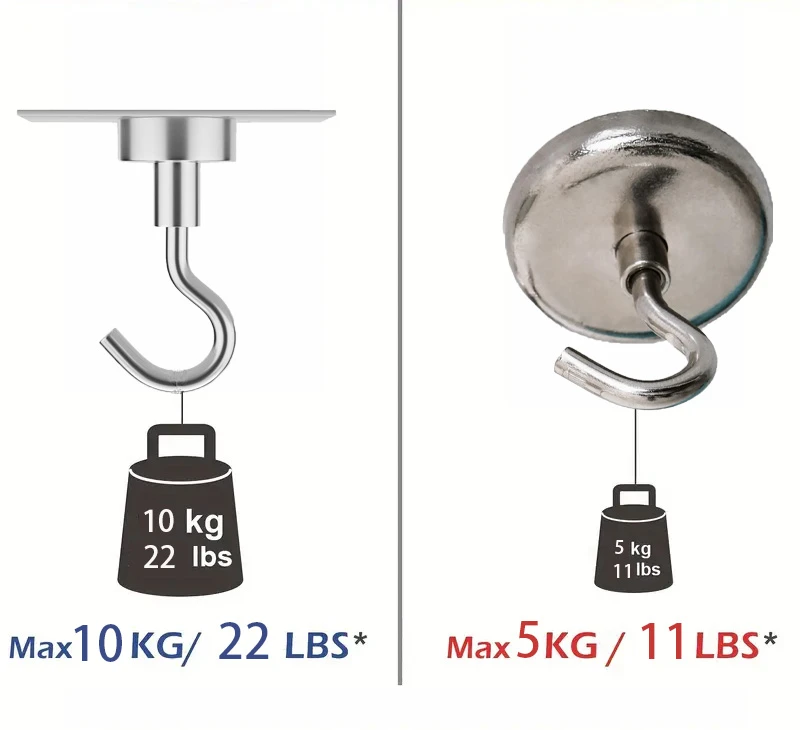
Magnetic hook magnetic strength display
The magnetic strength measurement of rare earth magnet hooks is mainly carried out by the following methods and standards:
1. Magnetic Field Strength Measurement
Units: Magnetic strength is usually expressed in Gauss (G) or Tesla (T). Gauss is a smaller unit and is often used for weaker magnetic fields, while Tesla is used for stronger magnetic fields.
Measuring tools: Use a Gaussmeter to directly measure the magnetic field strength on the surface of metal magnetic hooks. This device can provide accurate magnetic field strength readings to help users understand the magnetic force of stainless steel magnetic hooks.
2. Tension test
Pull test: The load-bearing capacity (i.e., pulling force) of magnetic utility hooks is usually measured by a pull test. This test involves contacting the hook with a ferrous surface and gradually applying a pulling force until the hook separates from the surface. The force required to separate is the pull force of the neodymium magnet hooks, usually recorded in Newtons (N) or pounds (lbs).
Test standards: Some standardized test methods (such as the MDFA tension test standard) will specify test conditions and procedures to ensure the reliability and repeatability of test results.
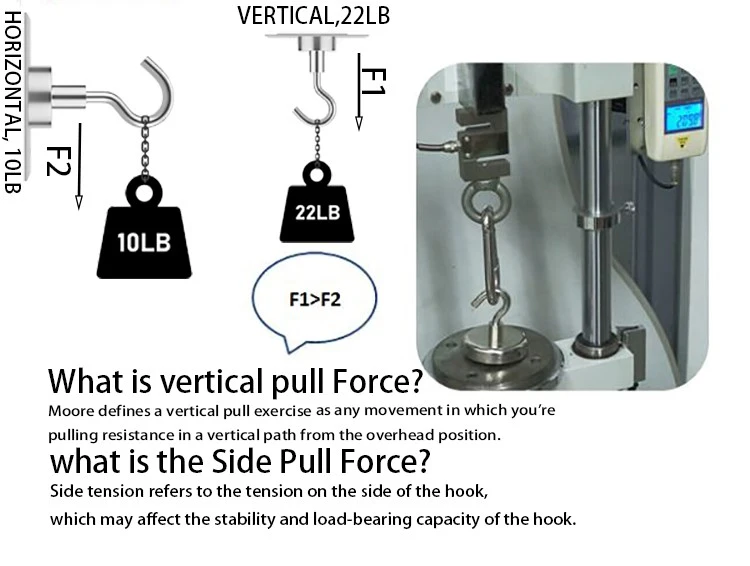
Magnetic ceiling hooks have a greater pull force than magnetic wall hooks
3. Magnetic flux density check
Magnetic Flux Density: The performance of magnetic hooks is evaluated by measuring the magnetic flux density at a specific distance. It is usually measured on the surface of the magnetic hook or in its working magnetic circuit to ensure that its material can work as expected.
4. Helmholtz coil test
Helmholtz coil: The magnetic characteristics of the magnetic hook can be measured more accurately using a Helmholtz coil. By placing the magnetic hook in the center of two coils, the current generated by the magnetic hook is measured, and the magnetic field strength and other related parameters are calculated.
Usage environment
- Mounting surface: The adsorption force of the magnetic mount hook is closely related to the material and state of the mounting surface. The magnetic effect is best when used on iron or other metal surfaces, while additional metal sheets are required on non-metallic surfaces to enhance the adsorption effect.
- Vertical and horizontal load: In the vertical direction, the load-bearing effect of the magnetic hook is generally better than horizontal placement, so vertical installation is a more ideal choice when hanging heavy objects.
Temperature: Temperature has a significant effect on magnetic force. High temperatures may cause the magnetism of the magnet to weaken, especially when it exceeds its operating temperature range. Therefore, the temperature of the installation environment should be kept within a suitable range.
Humidity: A humid environment may cause some types of magnets to rust, which will affect their magnetic force and service life.
When choosing the right magnetic peg hooks, you should consider several key factors:
1. Hanging weight: First determine the weight you need the hook to bear. Round magnet with hooks have different magnetic strengths. Choose a magnetic hook that can bear the weight of the item you need to hang. For example, QCM Magnet magnetic hooks of different sizes can provide magnetic pulling forces ranging from 8 kg to 80 kg.
2. Use environment: Consider the environment where the hook will be used. Different environments may require different types of magnetic hooks. For example, outdoor use may require stronger magnetic force to resist the effects of wind and temperature changes.
3. Material of the contact surface: Make sure the surface the hook contacts is ferromagnetic, because magnetic hooks for hanging can only work on ferromagnetic surfaces. Different types of metals and surface smoothness may affect the effect of magnetic hooks.
4. Hook type: Choose a swivel hook or a fixed hook according to your needs. The swivel hook can rotate freely, making it convenient to hang items; the fixed hook has a stronger load-bearing capacity and is safer when hanging loads vertically.
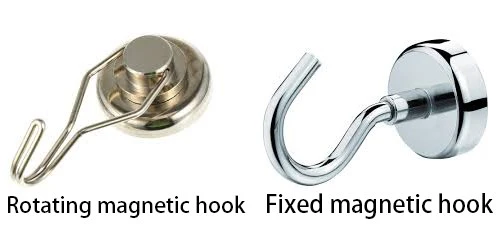
magnetic swivel hooks and fixed magnetic hook
5. Size and shape: Choose a magnetic hook size and shape that suits your needs. Some hooks may be smaller and suitable for home use, while others may be larger and suitable for industrial use.
6. Durability and quality: Choose a magnetic hook that is durable and reliable in quality. Some magnetic hooks may offer long-term guarantees or be made of high-quality materials, such as neodymium magnets, which are one of the strongest permanent magnet materials available.
7. Price and brand: Compare different brands and prices and choose the one that is the most cost-effective.
8. Ease of installation and use: Choose magnetic stainless steel hooks that are easy to install and use. Some magnetic hooks may require special tools or methods to install, while others may only require simple placement on a ferromagnetic surface.
9. Aesthetics: If you care about the appearance of the hook, choose a product with an aesthetically pleasing design and a color and shape that matches your environment.
10. Extra features: Some magnetic hooks may have extra features, such as a lockable handle, to ensure safety during use.
To sum up, the magnetic strength and load-bearing capacity of the magnetic hook will vary depending on the product design and usage environment. Choosing a suitable magnetic hook can improve efficiency and safety.


