


The magnetic rod consists of a magnetic core and a stainless steel housing. The core consists of an arrangement of cylindrical magnetic blocks and magnetic conductive sheet, and the 316 grade stainless steel housing makes it clean, smooth, low resistance and corrosion resistant. The arrangement of the internal magnetic blocks and magnetic conductive sheets allows the magnetic rod to have an even distribution of magnetic lines, making it easy to place the magnetic rod on a moving product transfer line.Magnetic rod is used to remove magnetic iron impurities in powder, granular, liquid or semi-liquid in ceramics, electricity, mining, plastics, chemicals, rubber, pharmaceuticals, food, environmental protection, pigments, dyes, electronics, metallurgy and other industries.
The magnetic rods themselves can be divided into the following types:
Based on magnetic materials:
Ferrite rods: relatively low-cost, suitable for removing ferromagnetic particles up to approximately 1 mm in size. This can be used, for example, to protect machines. Magnetic grids can also be manufactured using ferrite magnets.
Neodymium / Nd-Fe-B Magnetic Bars: Representing an ultra-strong permanent magnetic material, Nd-Fe-B Magnetic Bars exhibit excellent magnetic field penetration properties and can penetrate deep into materials to capture micron-sized ferromagnetic particles. Its strong magnetic properties enable it to effectively attract metal debris generated during the processing of stainless steel, even for low permeability stainless steel still maintains excellent capture ability. The magnets are used in industrial applications in high-gradient magnetic separation systems, magnetic filtration devices and as core components of powerful magnetic grids. Technical specifications cover a wide range of flux density classes, with measured values on the surface of austenitic stainless steel tubes in four standard gradients of 7,000, 9,000, 11,000 and 12,000 gauss. A specially designed quick-clean magnetic bar with integrated extraction tube structure ensures that the measured flux density is in high agreement with the actual working magnetic strength. It is important to note that the BR value (residual magnetic induction) is the core performance parameter that characterizes the intrinsic magnetic properties of the material and is the key indicator for assessing the final operating efficiency of the magnetic system.
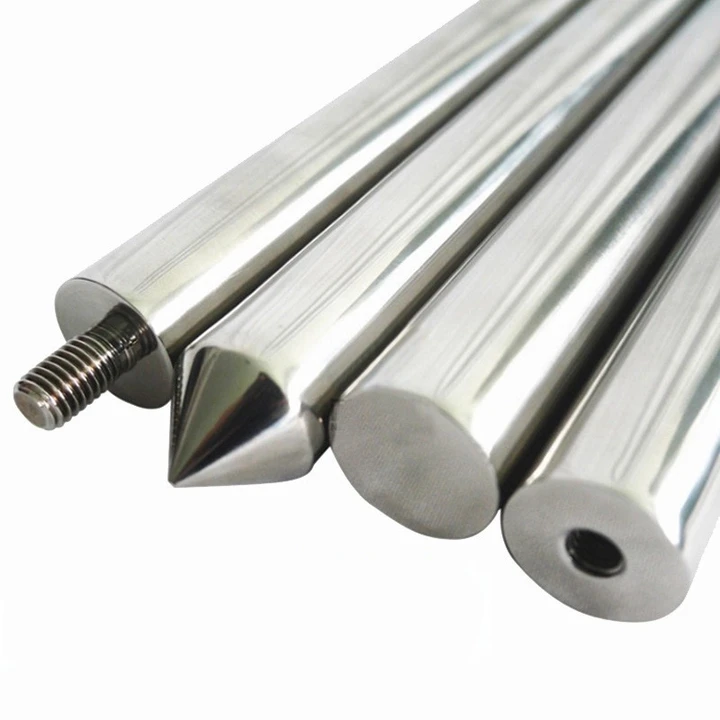
Based on construction or options:
Standard magnetic rods: with 1/4-inch threads on both ends for easy installation.
Unthreaded or studded magnetic rods: can be specified to order.
Pharmaceutical specification magnetic rods.
ATEX certified magnetic rods.
High-temperature version.
Magnetic rods are manufactured from 316-grade stainless steel tubing and other components with a surface finish of 0.6μm.
Magnetic rods are a fundamental part of a variety of magnetic systems that vary depending on the application and product characteristics. These systems include:
· Magnetic Grid: consists of a single layer of magnetic rods that are easy to assemble and have a low mounting height. Used for light ferromagnetic contaminants, sizes start at 1 mm. Ideal for simple applications or where a low mounting height is required. Available in round or square versions, using either ferrite or neodymium magnets. Powerful neodymium magnetic grids are available in a quick-clean version with extractor.
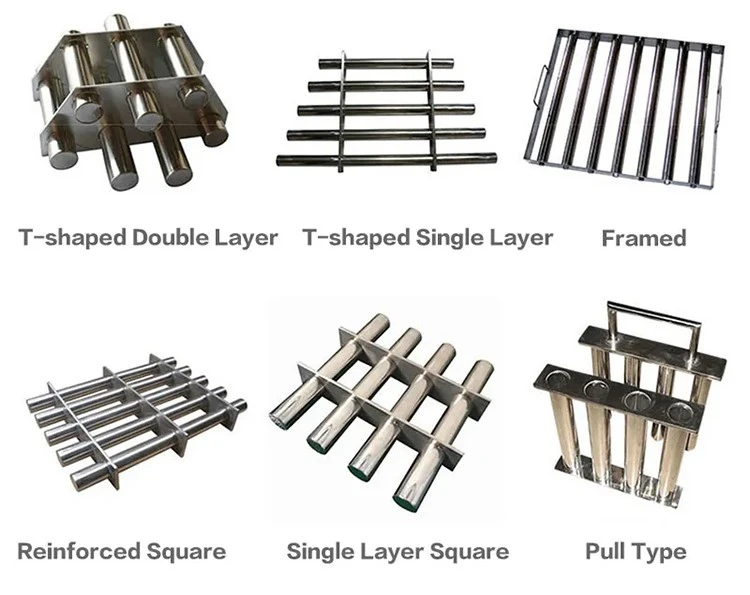
· Clean flow magnets: Multiple layers of magnets stacked in a housing. Usually two or more layers of magnetic bars are placed in a stainless steel housing. Standard versions have square inlets and outlets.
Self-cleaning clean flow magnets: with pneumatic cleaning for more ferrimagnetic contaminants, optional when more frequent cleaning is required. It is possible to pause the product flow or maintain a continuous product flow while cleaning.
Rotating Clean Flow Magnets: Magnetic bar rotation for viscous product flow. Used for large quantities of ferromagnetic contaminants, particles larger than 30 µm. The rotating motion helps to agitate the product and prevents it from sticking to the bar. Rotating clean flow magnets capture tiny ferromagnetic (dust) particles in fatty milk powders. Self-cleaning rotary clean flow magnets can remove metal particles as fine as 35 µm from powders.
Hygienic flow-through magnets: fully polished surface in accordance with EHEDG guidelines. EHEDG compliant with a smooth surface finish (0.8 µm). A new generation of neodymium magnets is used in self-cleaning magnetic rods to remove even weakly magnetic particles such as stainless steel 304.
Hydro form rotating clean flow magnets: For higher surface finish requirements, the housings are made of stainless steel tubes under high pressure, with no laser welds or dead spots. Available in manual or semi-automatic (pneumatic cleaning) versions.
· Magnetic filters: For the treatment of liquids or powders conveyed under pressure. Removes ferromagnetic particles from 5 µm in size. Powerful neodymium rods penetrate deep into the product and capture the smallest particles. Cleaning is performed by removing the rods from the product stream.
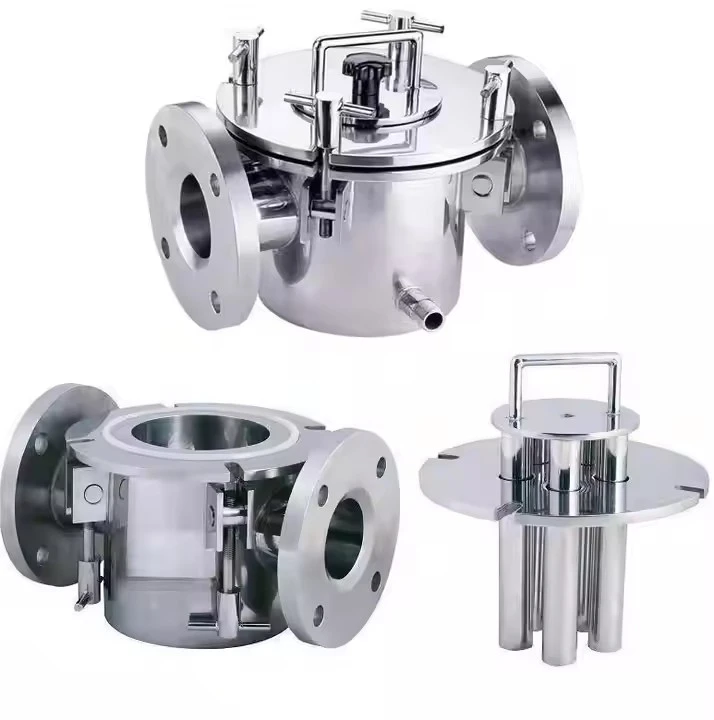
Industrial magnetic filter: for pressurized pipes up to 10 bar. Available in connection sizes DN50 to DN400. Standard cleaning is manual. Automatic self-cleaning magnetic rods are also available.
Industrial double-walled magnetic filters: for viscous products in pressurized pipes. Specifically designed to remove solidified products such as ferromagnetic particles of chocolate and keep the product liquid by passing hot water through the double-wall. Maximum pressure 10 bar, hot water pressure 3 bar.
Hygienic magnetic filter: in accordance with EHEDG guidelines. Specially developed for the food industry. Efficient separation of very small ferromagnetic particles from 7 - 30 µm, weakly magnetic stainless steel particles and even ferromagnetic dust from liquid and powdered products. The entire system is made of stainless steel 316 with a smooth surface (0.8 µm) and meets the highest standards of food safety. It can be installed in pipes in the food industry, the standard version is equipped with a Ø 25 mm magnetic bar. For products containing coarser ingredients (e.g. soup), they can be equipped with a single Ø 65 mm magnetic core.
Semi-automatic magnetic filter: developed for larger filters that are difficult to clean manually, a simple operation utilizes air pressure to blow the magnet package out of the product stream, dislodging particles. Equipped with Ø 33 mm magnetic rods for a stronger magnetic force.
High Gradient Separators are also systems that use very powerful (Nd-Fe-B) driven rolls to achieve separation. They are capable of attracting and removing paramagnetic or slightly magnetic materials, as well as very fine ferromagnetic dust from ceramic materials.


