


magnetic separation techonology
Magnetic separation technology is a technology that treats substances with magnetic fields, and the application of this technology has penetrated into various fields. Magnetic separation uses the magnetism of impurity particles in wastewater for separation, and for non-magnetic or weakly magnetic particles in water, magnetic inoculation technology can make them magnetic. With the help of the action of the external magnetic field, the magnetic suspended solids in the wastewater are separated, so as to achieve the purpose of purifying water.
Technical Feature
In recent years, magnetic separation has become an emerging water treatment technology. Magnetic separation as a physical treatment technology has gained many successful applications in water treatment and has shown many advantages. Magnetic separation uses the magnetism of impurity particles in wastewater to separate, for non-magnetic or weakly magnetic particles in water. Magnetic separation technology is a technology that treats substances with magnetic fields, and the application of this technology has penetrated into various fields.
The magnetic field itself is a field with special energy, the water or aqueous solution treated by the magnetic field, its optical properties, conductivity, dielectric constant, viscosity, chemical reaction and surface tension and adsorption, condensation and electrochemical effects and other aspects of the characteristics have produced measurable changes, and when the magnetic field is removed, this change can be maintained for hours or days, with a memory effect.
Due to the existence of these phenomena, magnetic technology has been a research hotspot for many years. Magnetic separation technology is a technology for magnetic field treatment of substances, the application of this technology has penetrated into various fields, the technology is the use of the difference in magnetic sensitivity of elements or components, with the help of external magnetic field to the material for magnetic field treatment, so as to achieve a strengthening of the separation process of an emerging technology.
With the advent of strong magnetic field and high gradient magnetic separation technology, the application of magnetic separation technology has changed from the separation of strong magnetic large particles to the removal of weak magnetic and diamagnetic fine particles, from the initial mineral sorting, coal desulfurization to industrial water treatment, from the separation of magnetic and non-magnetic elements to the separation of components of homogeneous mixture of diamagnetic fluids. As a clean, energy-efficient emerging technology, magnetic separation will show attractive development prospects. They can be made magnetic using magnetic inoculation techniques.
With the help of the action of the external magnetic field, the magnetic suspended solids in the wastewater are separated, so as to achieve the purpose of purifying water.
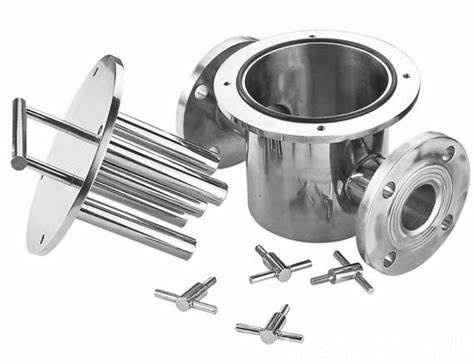
Advantages
1. Magnetic separation technology has high treatment efficiency
It treats wastewater with fast speed, large treatment capacity, and is not affected by natural temperature, and has a strong separation ability for extremely fine suspended solids and low-concentration wastewater that are difficult to remove by other separation methods. In particular, the filtration speed of the high-gradient magnetic filter separator is 10~30 times that of the high-speed filter used for general treatment, which is equivalent to 100 times that of the sedimentation tank.
2. The magnetic separation equipment is small in size, simple in structure, easy to maintain, low in cost, and occupies less land as high-gradient magnetic separation equipment, which is easy to realize automation;
Highly reliable work and moderate maintenance; Occupying less land, taking ordinary fast filter as an example, the magnetic filter occupies only 1/6 of its area, and the amount of civil construction is also very small, which can greatly shorten the construction period. Therefore, magnetic filters are especially suitable for small and medium-sized water plants and towns with tight land resources.
3. The use of high-gradient magnetic filtration can remove those pathogenic microorganisms, bacteria and some refractory organic matter with strong drug resistance and toxicity.
Studies have shown that magnetic field force can passivate or inactivate the water and enzymes in cells such as pathogenic microorganisms and bacteria, so that they can be killed, and the purpose of removal is achieved through magnetic filtration, and no harmful by-products are produced. Compared to disinfection with chlorine or chlorine preparations, this magnetic separation technology does not produce wastewater, but organic matter reacts with chlorine to produce trihalomethanes (THMs) and other halogenated hydrocarbon compounds, which are causative agents of a variety of diseases.
4. The operating cost is relatively low
For small and medium-sized water plants, compared with the traditional process (filter part), the increased operating cost (considered by adding iron powder during operation, the recovery rate is calculated by 80%) is 0.49 yuan / m3 (the test equipment is customized separately, and the cost is much higher than mass production), but the removal effect of the magnetic filter on organic matter in the water is much higher than that of the traditional process, and it can remove algae, and the effluent quality is better than the sand filter effluent.
Problems
Magnetic separation technology has the following technical difficulties and limitations in treating wastewater:
1. The residual magnetism of the medium makes it difficult for the magnetic separation equipment to flush the magnetic particles adsorbed by the polymagnetic medium during the backwashing of the system, thus affecting the work efficiency of the next cycle.
2. In order to improve the magnetic field gradient, it is necessary to choose a polymagnetic medium with high magnetic saturation, which has certain technical difficulties in the selection of the magnetic polymagnetic medium and increases the cost of operation.
Although magnetic separation technology is a simple and feasible water treatment technology with high treatment efficiency, due to the above technical difficulties and limitations, it needs to be overcome. Therefore, it affects its wide application in practical applications.
Compared with conventional methods such as sedimentation and filtration, magnetic separation method has a series of advantages such as large processing capacity, high efficiency, less energy consumption, simple and compact equipment, etc., it has not only been successfully applied to blast furnace gas washing water, steelmaking smoke purification wastewater, steel rolling wastewater and sintering wastewater purification, but also in other industrial wastewater, urban sewage


