


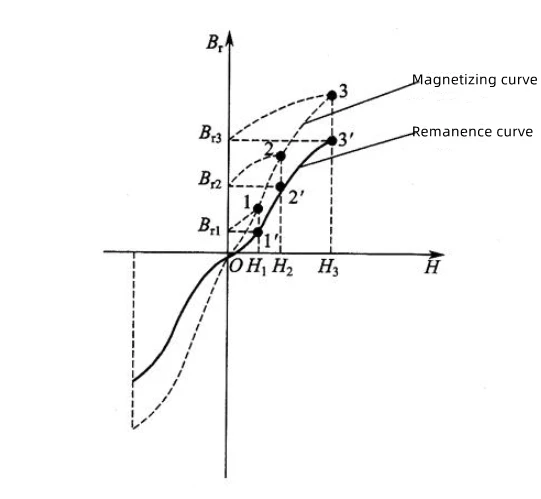
In the context of magnetism, remanence refers to the magnetization left in a magnetic material after an external magnetic field is removed. It is also commonly known as magnetic remanence or residual magnetism. Essentially, remanence is the ability of a material to retain its magnetic properties after the external influence (such as a magnetic field) has been switched off or removed.
How Does Remanence Work?
When a magnetic material is exposed to an external magnetic field, the magnetic domains within the material align with the field, causing the material itself to become magnetized. After the external magnetic field is removed, some of the magnetic domains remain aligned, causing the material to retain a certain level of magnetization. This retained magnetization is called remanence.
The level of remanence depends on the type of material and how easily its magnetic domains can remain aligned after the external field is removed. For example, materials like neodymium magnets have high remanence, meaning they can retain a strong magnetic field even without the external influence.
Types of Remanence
Permanent Remanence:
This is when the material retains its magnetic properties permanently, even without any external magnetic field. Permanent magnets, like neodymium or samarium-cobalt magnets, exhibit this type of remanence.
Temporary Remanence:
Some materials only retain their magnetic properties temporarily. For example, materials like soft iron have a much lower remanence. Once the external field is removed, they quickly lose their magnetization.
Key Factors Affecting Remanence
Material Composition: Different materials have different remanence levels. Harder magnetic materials like permanent magnets have high remanence, while soft magnetic materials (like iron) tend to have low remanence.
External Magnetic Field Strength: The stronger the external magnetic field, the greater the degree of magnetization and, consequently, the higher the remanence that is retained after the field is removed.
Magnetic Hysteresis: This refers to the phenomenon where the magnetization of a material does not immediately return to its original state after the external field is removed. The area of the hysteresis loop can indicate the material's remanence.
Importance of Remanence
Magnetic Storage: Remanence is essential for applications like hard drives, where data is stored in the form of magnetic domains. The ability of the material to maintain its magnetization is key to the functionality of these storage systems.
Permanent Magnets: The strength of a permanent magnet's field, which is largely determined by its remanence, is crucial for many applications, such as in electric motors, speakers, and magnetic tools.
Magnetic Sensors: Remanence plays a role in magnetic sensors, which are used to detect the presence of magnetic fields in a variety of technologies, including industrial machinery and consumer electronics.
Conclusion
Remanence is a fundamental concept in magnetism that describes the residual magnetization that remains in a material after an external magnetic field has been removed. It is a crucial property for many applications, particularly in the fields of magnetic storage, permanent magnets, and sensor technologies. The level of remanence a material exhibits determines its ability to retain magnetic properties, making it an essential factor in the design and use of magnetic products.


